What is the "no kings protest" in Los Angeles about?
LA's "No Kings" protests challenged executive power, focusing on immigration raids and perceived monarchical rule.
 Sylvie Vance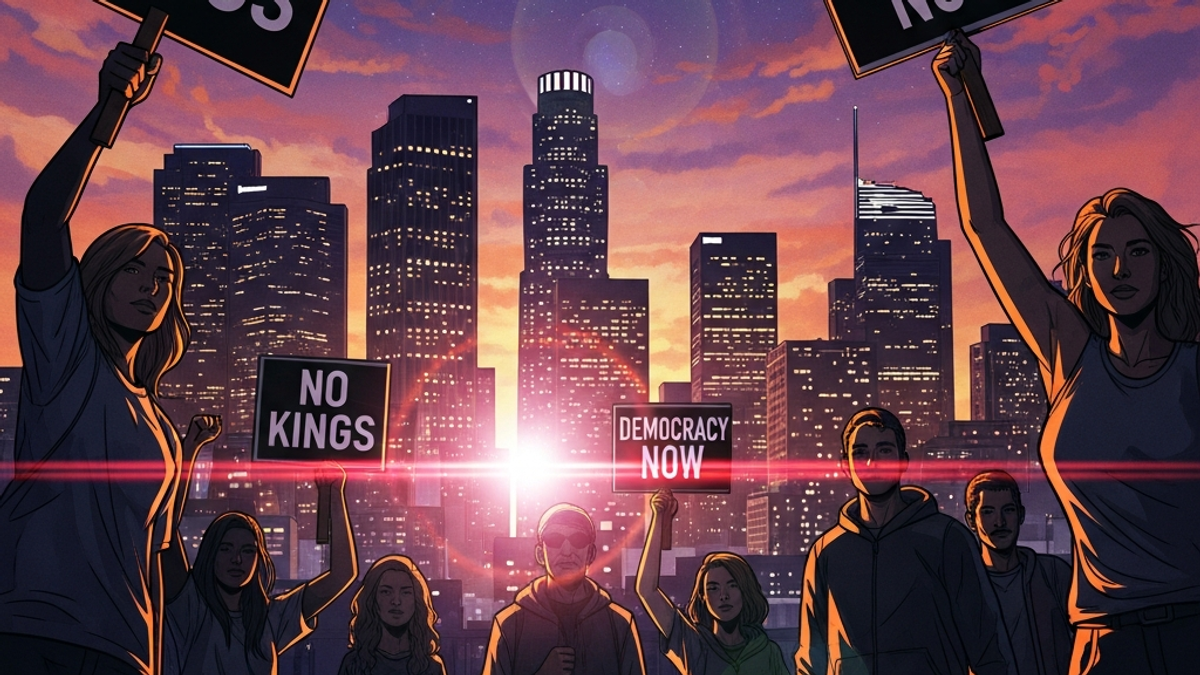
The "No Kings" protests in Los Angeles were a significant part of nationwide demonstrations organized to voice strong opposition to a sitting U.S. President's administration, centering on claims of antidemocratic policies and an executive style likened to that of a monarch [1]. Specifically, the demonstrations in Los Angeles were heavily galvanized by the administration's aggressive stance on immigration, including federal raids and the deployment of the National Guard to protect federal officers, which protesters viewed as an overreach of executive power [1, 2]. This movement contrasts the authority of the presidency with the principles of democratic governance, urging citizens to reject what organizers termed a \"hostile government takeover\" [3].
### What is the symbolic meaning behind the "No Kings" slogan in political protest?
The "No Kings" slogan carries deep historical and political weight, directly challenging the concept of a ruler who operates above the law or democratic accountability [3]. In the context of these specific protests, the term serves as a powerful rhetorical device comparing the actions of the criticized administration—specifically its strong executive orders and disregard for institutional norms—to monarchical rule rather than that of a democratically elected president [3]. Organizers aimed to \"dethrone\" the president figuratively through mass mobilization, asserting that the office demands service to the people, not autocratic authority [3]. The slogan taps into a fundamental American skepticism toward centralized, unchecked power, echoing sentiments against authoritarianism that surface during periods of perceived political instability [1].
### How did federal immigration actions in Los Angeles specifically fuel the intensity of these protests?
Federal immigration enforcement actions served as a major, immediate catalyst for the high turnout and intensity of the "No Kings" protests in the Los Angeles area [1, 2]. The deployment of the National Guard to the city to support federal immigration officers, an action taken in response to perceived local resistance or "rebellion" against federal mandates, significantly agitated opponents of the administration [1]. Protesters saw this mobilization as a militarization of domestic policy enforcement and a clear example of executive overreach that threatened civil liberties [1]. In Southern California, where immigration issues are central to the political and social landscape, these federal actions provided a concrete, local focus for the broader national critique of the administration's policies [2].
### What were the main policy critiques driving the demonstrations in Southern California?
While the overarching theme was a rejection of perceived monarchical executive power, the demonstrations in Southern California were heavily driven by specific policy grievances, most notably regarding immigration enforcement [1, 3]. Protesters rallied against the consequences of federal immigration raids and the aggressive posture of the administration toward undocumented communities [1, 2]. Beyond immigration, the demonstrations often encompassed broader denouncements of the administration's directives, which organizers felt constituted a hostile redirection of governmental priorities [3]. The scale of mobilization in LA was also, at times, framed as a direct counter-event to high-profile displays of executive power, such as large military celebrations [3].
### What was the observable impact of the Los Angeles mobilization on subsequent political discourse?
The Los Angeles mobilization, due to its size and the volatile context involving federal and local forces, contributed significantly to the national narrative surrounding the administration's legitimacy and handling of civil unrest [1]. The comparison of protests and police responses—where law enforcement allegedly used batons and tear gas against demonstrators—created powerful visual evidence used by critics to support their claims of authoritarian tendencies [1]. Large-scale demonstrations like those in LA were intended by organizers to represent the largest single-day mobilization against the administration, aiming to project a broad base of opposition that would influence political discourse and future policy considerations by demonstrating the high cost of perceived heavy-handed governance [3].
## Key Takeaways
* **Symbolic Challenge:** The "No Kings" slogan directly attacks the perceived autocratic style and antidemocratic policies of the administration being protested.
* **LA Catalyst:** Federal immigration raids and the deployment of the National Guard in Los Angeles acted as a specific, high-intensity trigger for local participation [1, 2].
* **Democratic Assertion:** The protests fundamentally serve as an assertion of democratic principles against what organizers view as an executive power grab [3].
* **Sustained Movement:** The LA events were part of a coordinated, nationwide effort, highlighting widespread, organized dissent across thousands of locations [3, 4].
The sustained nature of these protests suggests that the underlying tensions regarding executive power and federal enforcement in sensitive areas like immigration remain a critical fault line in American politics. Understanding the evolution of slogans like "No Kings" provides insight into how citizens translate complex legal and political frustrations into unifying, powerful calls for accountability.
## Conclusion
The "No Kings" protest in Los Angeles was far more than a local event; it was a potent, localized flashpoint in a national movement designed to challenge the scope and style of executive authority. Driven by specific, impactful federal policies concerning immigration and amplified by visible displays of state power, the demonstrations served as a crucial expression of civic resistance. As political tensions continue to reshape public engagement, the legacy of these events underscores the enduring importance of organized protest in checking perceived overreaches of government, ensuring that the fundamental principle of democratic governance—that no one is above the law—remains central to the national dialogue.
## References
* [1] https://www.britannica.com/event/No-Kings-protests
* [2] https://www.nbclosangeles.com/news/local/what-to-know-about-no-kings-protests-in-los-angeles/3724171/
* [3] https://www.pbs.org/newshour/politics/what-to-know-about-no-kings-protests-against-trumps-policies
* [4] https://www.theguardian.com/us-news/2025/oct/17/no-kings-protests-millions-trump