What methods or tactics are commonly used in "no kings protests"?
The "No Kings" protests utilized non-violent direct action and potent symbolism to contest perceived executive overreach and advocate for the supremacy of the rule of law. The protests aimed to establish vertical accountability, ensuring that even executive actions are subject to legal and public scrutiny.
 Sylvie Vance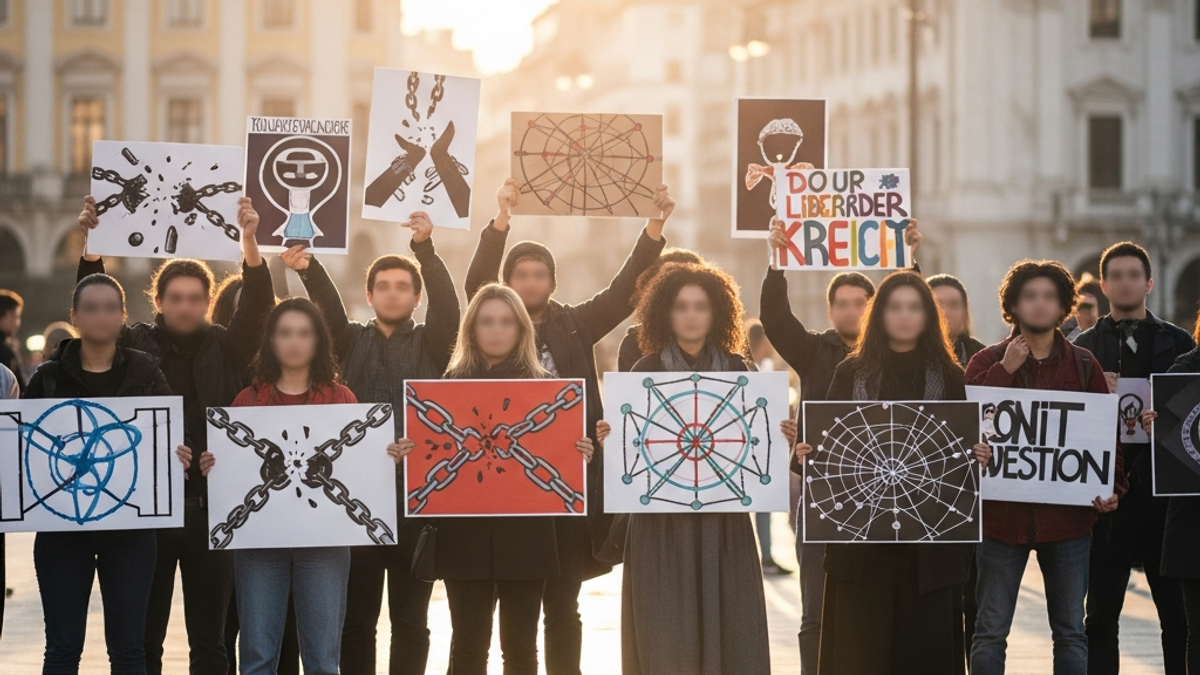
"No Kings" protests primarily employ **mass mobilization, focused symbolic messaging, and direct, non-violent civil disobedience** aimed at challenging perceived executive overreach and asserting the supremacy of democratic law over any single leader. These demonstrations utilize tactics ranging from large-scale street marches, often in response to specific executive actions like immigration raids, to focused symbolic actions designed to simplify complex legal and political issues into fundamental democratic truths (https://democratic-erosion.org/2026/03/09/the-no-kings-movement-can-public-outcry-halt-stealth-authoritarianism/). A notable tactical element involves applying pressure through sustained public visibility to remind the government that, in a democracy, the only "king" is the law itself (https://democratic-erosion.org/2026/03/09/the-no-kings-movement-can-public-outcry-halt-stealth-authoritarianism/). In some instances, particularly when federal intervention is present, these protests have escalated to confrontations where law enforcement has used force, such as batons and tear gas, against demonstrators (https://www.britannica.com/event/No-Kings-protests).
### What is the core philosophical underpinning or unifying message of the "No Kings" movement?
The central message of the "No Kings" movement is a firm rejection of authoritarian tendencies within the executive branch and an insistence on maintaining the system of checks and balances inherent in democratic governance. The movement views the actions of targeted leaders as an attempt to achieve "stealth authoritarianism" by reshaping government institutions into tools for personal or partisan rule (https://democratic-erosion.org/2026/03/09/the-no-kings-movement-can-public-outcry-halt-stealth-authoritarianism/). The phrase itself is a powerful rhetorical device that simplifies nuanced debates about executive authority into a fundamental, easily understood democratic principle: no single individual is above the rule of law. This philosophical commitment drives the movement to assert "vertical accountability," meaning the people retain the power to hold leaders responsible (https://democratic-erosion.org/2026/03/09/the-no-kings-movement-can-public-outcry-halt-stealth-authoritarianism/).
### Beyond standard rallies, what specific strategic communication tactics—such as slogans or symbolism—are employed?
The effectiveness of "No Kings" protests relies heavily on clear, resonant communication tactics. Strategically, the movement often focuses on unifying around a single, potent symbol or phrase that crystallizes widespread public discontent. The slogan "No Kings" serves this purpose perfectly, directly referencing historical precedents and fundamental American ideals regarding monarchy. Furthermore, as a tactic, protest is not an end but a tool requiring strategic deployment; groups involved often discuss the need to avoid "tactical freeze" by ensuring demonstrations are integrated into a broader strategy for achieving tangible political outcomes (https://indivisibleteam.medium.com/the-strategic-logic-of-the-no-kings-protests-e92e9dd27465). Beyond the core slogan, tactics involve translating frustration into actionable political moments, where the act of protesting is seen as the crucial first step toward pushing for necessary institutional reform (https://democratic-erosion.org/2026/03/09/the-no-kings-movement-can-public-outcry-halt-stealth-authoritarianism/).
### How do the tactics of "No Kings" protests differ from traditional political demonstrations, and what is their intended political impact?
While "No Kings" protests incorporate traditional tactics like mass rallies, their distinguishing feature is their targeted nature against perceived institutional corrosion rather than mere policy disagreement. Where traditional protests might focus on a specific bill, these demonstrations focus on the *role* of the executive itself, challenging the legitimacy of actions perceived as monarchical (e.g., statements about being a king or expanding executive power beyond constitutional bounds) (https://www.britannica.com/event/No-Kings-protests). The intended political impact is dual: first, to exert immediate public pressure, often in response to high-profile events like immigration raids or court rulings (https://www.britannica.com/event/No-Kings-protests); and second, to serve as a sustained "signal" that the populace will not passively accept the erosion of democratic norms (https://democratic-erosion.org/2026/03/09/the-no-kings-movement-can-public-outcry-halt-stealth-authoritarianism/). Organizers often frame these protests as necessary precursors to deeper, long-term institutional reform (https://democratic-erosion.org/2026/03/09/the-no-kings-movement-can-public-outcry-halt-stealth-authoritarianism/).
### What are the documented responses or counter-measures to these protest tactics?
The tactics utilized in "No Kings" protests have frequently elicited strong responses from authorities, particularly when demonstrations occur in areas targeted by federal operations or when viewed as threats to public order. In situations involving high tension, such as those seen in Los Angeles amid immigration raids, law enforcement responses have included the deployment of the National Guard to protect federal officers (https://www.britannica.com/event/No-Kings-protests). Furthermore, police presence has sometimes escalated to the use of force, including batons and tear gas, when demonstrators allegedly threw projectiles like bricks or fireworks (https://www.britannica.com/event/No-Kings-protests). Protesters have also developed de-escalation and safety strategies to manage potential confrontation, often employing methods like the "5-D Method (Distract, Delegate, Document, Delay, Direct)" to navigate high-risk environments (https://www.interfaithalliance.org/documents/no-kings-de-escalation-rights-resources).
## Key Takeaways
* **Symbolic Clarity:** The effectiveness of the "No Kings" approach is rooted in using a highly symbolic phrase to simplify complex constitutional concerns into a universally understood message against unchecked power.
* **Dual Focus:** Tactics target both immediate, visible executive actions (like immigration crackdowns) and the long-term erosion of democratic institutions.
* **Accountability Mechanism:** The core objective is asserting "vertical accountability"—the power of the populace to check the executive branch.
* **Risk Acknowledgment:** Protesters are often aware of the potential for official countermeasures, leading to the development of parallel safety and de-escalation protocols.
The future success of movements utilizing these anti-monarchical protest tactics will likely depend on their ability to effectively transition the initial energy and symbolic outcry into concrete, lasting institutional reforms, ensuring that the challenge to executive authority translates into measurable systemic change rather than remaining purely an expression of popular dissent.
In conclusion, understanding "No Kings" protests requires looking beyond the surface-level demonstrations to appreciate the deep strategic thought underpinning their methodology. By coupling powerful, resonant symbolism with direct, sustained public action, these movements seek to enforce a fundamental tenet of liberal democracy: that the law, not any single individual, reigns supreme. The enduring relevance of this tactic lies in its adaptability to any political moment where executive power is perceived to have stretched beyond its constitutional mandate.
## References
* https://www.britannica.com/event/No-Kings-protests
* https://indivisibleteam.medium.com/the-strategic-logic-of-the-no-kings-protests-e92e9dd27465
* https://www.interfaithalliance.org/documents/no-kings-de-escalation-rights-resources
* https://democratic-erosion.org/2026/03/09/the-no-kings-movement-can-public-outcry-halt-stealth-authoritarianism/