**When did the "no kings protest" in Los Angeles begin?**
The "No Kings" protests in Los Angeles commenced in June 2025, driven by discontent over alleged executive overreach and federal immigration enforcement actions.
 Sylvie Vance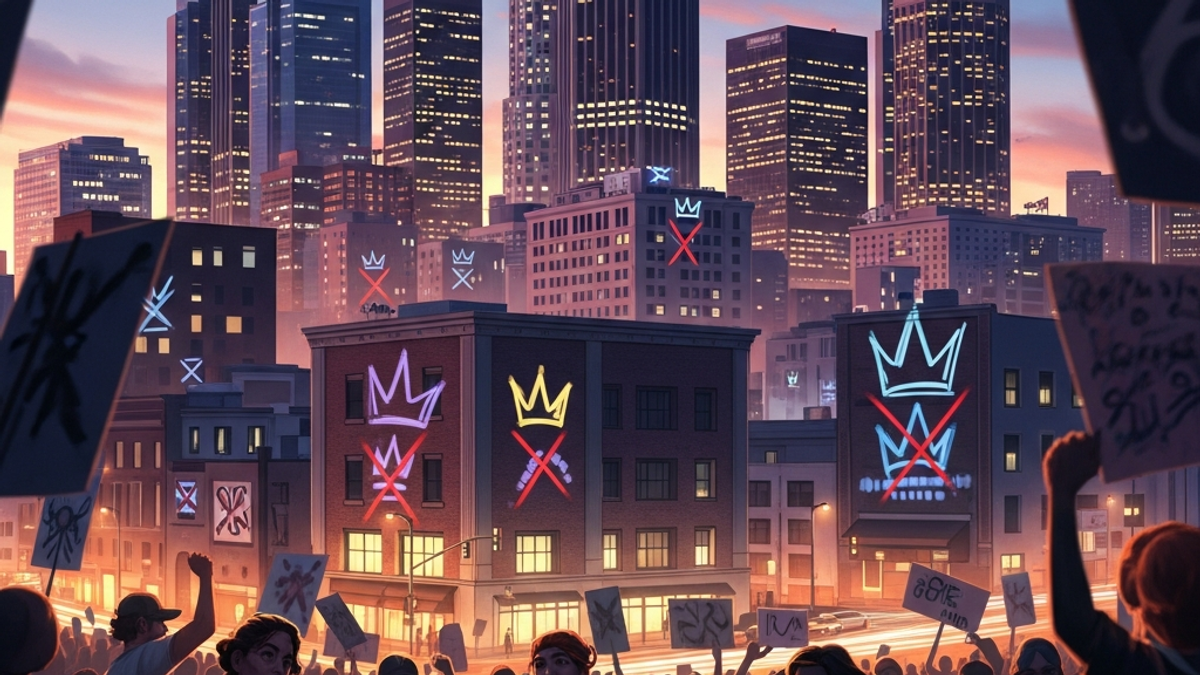
The initial, high-profile iteration of the “No Kings” protests in Los Angeles is generally associated with demonstrations that took place in **June 2025**, coinciding with the U.S. Army’s 250th anniversary celebration and President Donald Trump's birthday, where hundreds of thousands across the nation marched against perceived antidemocratic policies and overreach by the administration, including actions related to federal immigration raids in the city [^1, ^4, ^5]. This movement saw particularly robust turnout in Southern California, with early demonstrations in downtown Los Angeles drawing a reported 30,000 protesters, setting the stage for subsequent rallies in October of the same year [^3, ^4].
### Why was the protest named the “No Kings” demonstration?
The moniker “No Kings” serves as a pointed rhetorical rejection of executive power perceived as monarchical or dictatorial, specifically targeting the sitting U.S. President [^1]. The name directly references statements or policies by the administration that protesters viewed as antidemocratic or an overreach of authority, effectively framing the leader as someone operating outside the established constitutional norms [^1]. Organizers, such as the No Kings Coalition, explicitly stated their intent was to stand in solidarity against "the constant chaos of the Trump administration, and they’re ready to stand in solidarity against its overreach and attacks on the American people and immigrants” [^5]. This symbolic naming strategy aimed to mobilize citizens by contrasting the concept of a democratically elected official with that of an unchecked sovereign.
### What were the primary catalysts for the initial Los Angeles demonstrations?
The initial impetus for the large-scale “No Kings” protests in Los Angeles was multifaceted, rooted in both political symbolism and immediate local concerns. A major contributing factor was the planned timing of the demonstrations to overlap with the U.S. Army’s 250th anniversary parade and the sitting President’s birthday in June 2025 [^5]. Critically, the protests were also fueled by immediate, tangible tensions stemming from federal activities within the city, particularly widespread unrest in response to federal immigration raids [^1]. These raids generated significant local backlash, leading to violent confrontations between law enforcement and protesters in areas where the National Guard had been deployed to protect federal immigration officers [^1]. Furthermore, activists drew parallels between current detention conditions and historical atrocities, with some referring to immigrant detention centers near Los Angeles as “concentration camps” [^3].
### How did the scale and frequency of the Los Angeles protests evolve after the initial event?
Following the substantial turnout of the initial protest wave in June 2025, the “No Kings” movement demonstrated significant staying power in Los Angeles. The first large mobilization in downtown LA drew an estimated 30,000 participants [^4]. The movement did not dissipate; instead, it returned later that year. For instance, a second, nationwide “No Kings” protest occurred on October 18, 2025, which also drew large crowds, including planned demonstrations throughout Los Angeles County [^1, ^4]. Organizers continued to schedule multiple events across the metro area; prior to a later planned Saturday rally, over 50 events were anticipated in the L.A. area alone, with one expected to draw over 100,000 people in downtown Los Angeles [^2]. This consistent scheduling and large expected attendance underscore the sustained mobilization capacity of the movement in the region.
### What were the documented impacts or responses from local authorities to the LA protests?
The response from local authorities in Los Angeles to the mass demonstrations was characterized by heavy police presence and, at times, confrontation. During the initial June protests, after a large, largely peaceful march in downtown Los Angeles, the LAPD issued a dispersal order and employed "less than lethal weapons" against the crowd, claiming protesters were throwing objects like rocks and bottles [^2]. In response to the unrest surrounding immigration issues, the President reportedly ordered the National Guard to report to the city to protect federal officers [^1]. Conversely, local city officials also sought to reinforce public trust, with figures like Rodriguez emphasizing that Angelenos could trust public servants not to engage in activities that would compromise their roles or the necessary level of public trust [^3].
## Key Takeaways and Future Outlook
Understanding the genesis and evolution of the “No Kings” protests in Los Angeles provides crucial insight into the nature of modern political mobilization.
* **Origin Point:** The movement coalesced around specific political moments in **June 2025**, linking opposition to federal immigration policies with broader symbolic resistance against executive power.
* **Symbolism is Key:** The "No Kings" nomenclature proved effective in framing the political opposition in stark, easily digestible terms of democracy versus authoritarianism.
* **Sustained Activism:** The ability to organize multiple, large-scale events across the Los Angeles area months apart demonstrates robust organizational capability within the coalition.
* **High-Tension Environment:** The events were marked by significant tension, resulting in police dispersal orders and the deployment of the National Guard in response to clashes over federal actions.
The future impact of this type of organized, ideologically driven demonstration lies in its potential to shift public dialogue and influence local policy debates, particularly around civil liberties and the scope of federal authority within metropolitan areas. The template established by the LA protests—linking specific grievances (like immigration) to broad symbolic language (like "No Kings")—remains a powerful tool for future organizing efforts.
## References
[^1]: Britannica. *“No Kings” protests | Meaning, Turnout, Numbers, & Around the World*.
[^2]: LAist. *Nationwide No Kings protests return Saturday. What you need to know*.
[^3]: LAist. *No Kings protests - Los Angeles - LAist*.
[^4]: Los Angeles Times. *41 No Kings rallies planned for L.A. Saturday. Where are they?*.
[^5]: USA Today. *What time are 'No Kings' protests in Los Angeles? See list*.