## Why is the Giant Phantom Jellyfish's anatomy different from other jellyfish?
The Giant Phantom Jellyfish, Stygiomedusa gigantea, is characterized by its use of four specialized oral arms to capture prey and its habitat deep within the dark bathypelagic zone.
 Sylvie Vance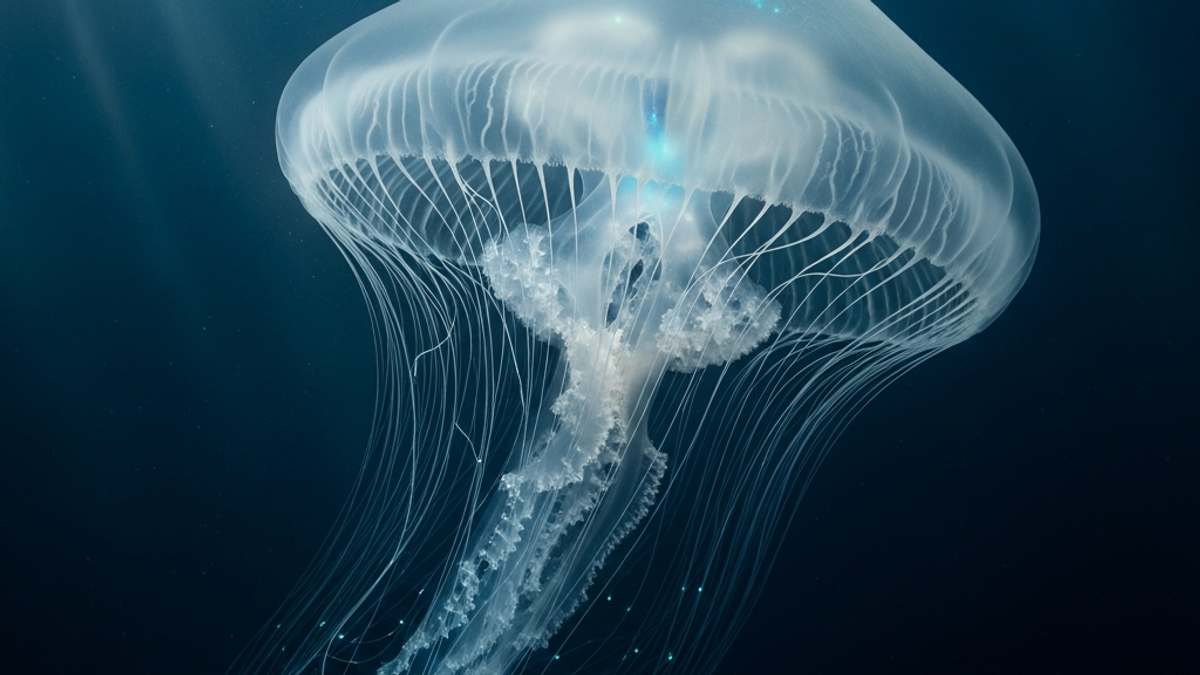
The anatomical distinction of the Giant Phantom Jellyfish lies primarily in its oral arms, which are specialized for feeding rather than defense or venom delivery. While most jellyfish possess numerous fine, nematocyst-laden tentacles used for stunning prey and defense, *Stygiomedusa gigantea* has only four thick, trailing oral arms that can extend up to 33 feet (https://www.reddit.com/r/NatureIsFuckingLit/comments/ra9j9r/a_giant_phantom_jellyfish_that_traps_its_prey_with_33/). These arms are described as being slippery and are used to envelop and trap prey, which primarily consists of small crustaceans and other deep-sea organisms (https://www.a-z-animals.com/articles/meet-the-phantom-jellyfish-that-drifts-through-total-darkness/). This physical difference suggests an adaptation specifically tuned to the low-prey density environment of the bathypelagic zone, where efficiency in capturing larger, slower-moving meals is key. Furthermore, some reports suggest these arms may only sting other jellyfish species, highlighting a highly specialized ecological niche (https://www.reddit.com/r/NatureIsFuckingLit/comments/ra9j9r/a_giant_phantom_jellyfish_that_traps_its_prey_with_33/).
### How often is the Giant Phantom Jellyfish observed, and why is it considered "rare"?
The Giant Phantom Jellyfish is considered rare primarily due to its habitat: the deep ocean, often below 1,000 meters (3,300 feet) (https://www.the-sun.com/tech/15888242/rare-phantom-jellyfish-bus-size-stygiomedusa-gigantea/). Observations are infrequent because they require specialized equipment, such as Remotely Operated Vehicles (ROVs) and deep-diving submersibles, to reach their bathypelagic zone. Despite being rarely seen, scientists believe the species is actually widespread across the world’s major oceans, including the Pacific, Atlantic, and Indian Oceans (https://www.the-sun.com/tech/15888242/rare-phantom-jellyfish-bus-size-stygiomedusa-gigantea/). Its massive size, with the bell alone reaching nearly one meter in diameter, makes any sighting a significant event in marine biology (https://www.popsci.com/environment/giant-phantom-jellyfish-spotted-deep-in-pacific/).
### What is the primary threat or danger associated with this jellyfish, if not stinging?
Since the Giant Phantom Jellyfish does not pose a direct sting threat to humans, the primary danger associated with it relates to mistaken identity or unverified claims. While the consensus among marine biologists is that its oral arms are non-stinging to humans, anecdotal reports on forums have occasionally suggested otherwise or indicated lethality (https://www.quora.com/Do-we-know-how-deadly-the-giant-phantom-jellyfish-is/). Such claims, however, lack credible scientific backing, and the actual interaction risk for humans is virtually zero due to its extreme depth (https://www.popsci.com/environment/giant-phantom-jellyfish-spotted-deep-in-pacific/). The true 'threat' this species poses is mostly to its own prey, which it traps using its unique morphology (https://www.a-z-animals.com/articles/meet-the-phantom-jellyfish-that-drifts-through-total-darkness/).
### How does the Giant Phantom Jellyfish survive in the extreme deep-sea environment?
Survival in the crushing pressures and perpetual darkness of the bathypelagic zone requires significant biological adaptation. The Giant Phantom Jellyfish conserves energy by moving slowly, drifting with the deep-sea currents, which is crucial in an environment where food is scarce (https://www.a-z-animals.com/articles/meet-the-phantom-jellyfish-that-drifts-through-total-darkness/). Its large, dark red/black coloration provides excellent camouflage in the lightless depths, making it nearly invisible to both predators and potential prey (https://www.the-sun.com/tech/15888242/rare-phantom-jellyfish-bus-size-stygiomedusa-gigantea/). The lack of traditional stinging tentacles is likely an evolutionary trade-off, prioritizing the capture of larger, slower-moving organisms via engulfment rather than relying on quick, venomous strikes needed in shallower, more competitive waters.
## Key Takeaways & Future Outlook
The recent renewed interest in the Giant Phantom Jellyfish stems from its sheer size and unusual morphology, which prompts a necessary re-evaluation of jellyfish classification and function.
* **Non-Stinging Defense:** The signature characteristic is the absence of stinging tentacles; it uses four large oral arms for prey capture.
* **Habitat Isolation:** Its primary rarity is due to its deep-sea dwelling (bathypelagic zone), not true scarcity.
* **Energy Conservation:** Slow movement and dark coloration are key adaptations for survival in the low-resource deep ocean.
* **Low Human Risk:** Due to its depth, direct human interaction is almost non-existent, and its physical features do not suggest a sting hazard.
The future study of *S. gigantea* will likely rely on advanced ROV technology to better understand its reproductive cycle and dietary specifics, offering profound insights into deep-sea ecosystem dynamics.
The Giant Phantom Jellyfish stands as a powerful reminder that the vast majority of our planet remains unexplored. While the immediate question of its sting hazard yields a reassuring "no," the creature itself embodies a complex evolutionary success story perfectly adapted to one of Earth’s harshest environments. Its continued, albeit infrequent, appearance in our submersibles challenges us to look beyond superficial features and appreciate the diverse strategies life employs to thrive in the dark.
## References
* https://www.reddit.com/r/NatureIsFuckingLit/comments/ra9j9r/a_giant_phantom_jellyfish_that_traps_its_prey_with_33/
* https://www.quora.com/Do-we-know-how-deadly-the-giant-phantom-jellyfish-is
* https://www.popsci.com/environment/giant-phantom-jellyfish-spotted-deep-in-pacific/
* https://www.a-z-animals.com/articles/meet-the-phantom-jellyfish-that-drifts-through-total-darkness/
* https://www.the-sun.com/tech/15888242/rare-phantom-jellyfish-bus-size-stygiomedusa-gigantea/