How large can a giant phantom jellyfish grow?
The giant phantom jellyfish is one of the largest deep-sea invertebrates, identifiable by its massive bell and unique ribbon-like oral arms.
 Sylvie Vance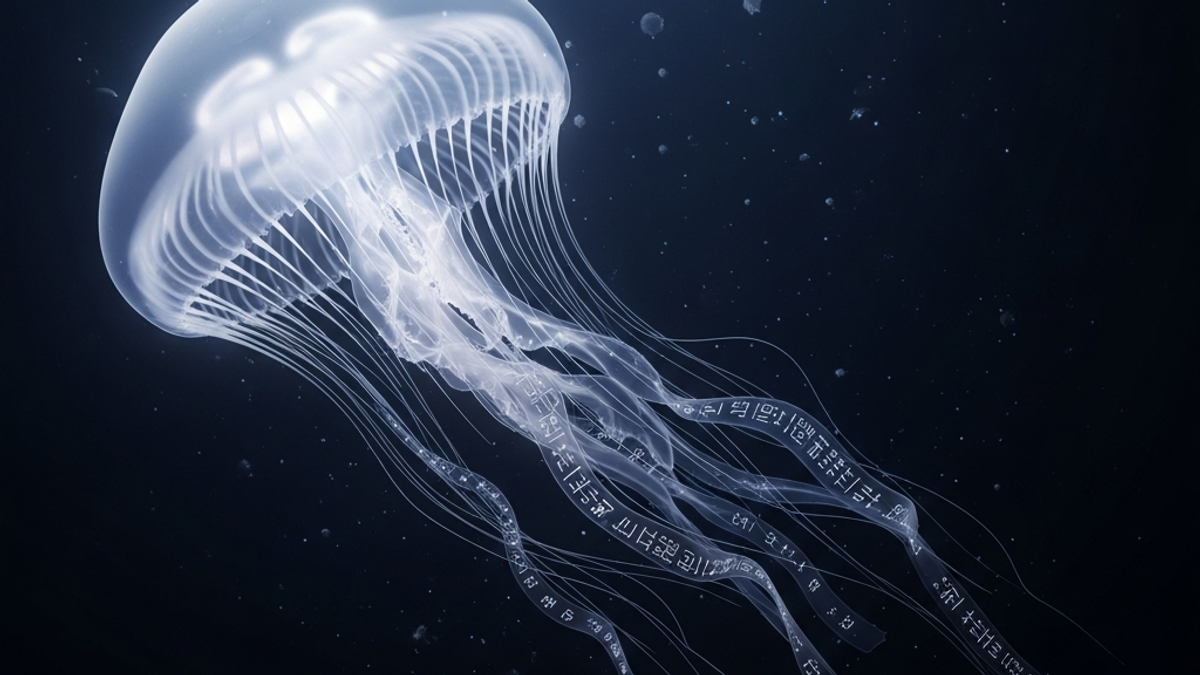
The giant phantom jellyfish (*Stygiomedusa gigantea*) can grow to an impressive size, featuring a bell that can exceed **1 meter (3.3 feet) across** and trailing oral arms that can reach lengths of **10 meters (33 feet)** (https://www.mbari.org/animal/giant-phantom-jelly/). This massive size makes it one of the largest deep-sea invertebrates, a characteristic that fuels public fascination whenever new footage of this elusive creature surfaces. Given its rarity, understanding the dimensions of this deep-ocean giant helps contextualize the challenges scientists face in studying life in the abyssal zone.
### Why are sightings of the giant phantom jellyfish so rare despite its large size?
The infrequency of sightings is directly attributable to its extreme habitat, which necessitates specialized technology for observation. The giant phantom jelly has been recorded at depths ranging from the surface down to **6,700 meters (22,000 feet)** (https://www.mbari.org/animal/giant-phantom-jelly/). To study these animals intact, researchers rely on Remotely Operated Vehicles (ROVs), such as those used by the Monterey Bay Aquarium Research Institute (MBARI), as traditional methods like trawl nets destroy their delicate, gelatinous bodies (https://www.youtube.com/watch?v=9bzQYKm3xTA). Even with advanced technology, only about 110 sightings have been logged since the species was first collected in 1899, highlighting the vast, unexplored nature of its environment (https://www.youtube.com/watch?v=9bzQYKm3xTA).
### What distinguishes the giant phantom jelly from other large jellyfish species?
While its size is notable, the unique morphology of the giant phantom jelly sets it apart from more common, surface-dwelling jellyfish. Unlike typical jellyfish that use their trailing tentacles for stinging and capturing prey, *Stygiomedusa gigantea* possesses four thick, ribbon-like oral arms surrounding its mouth (https://www.livescience.com/animals/jellyfish/giant-phantom-jelly-the-33-foot-long-ocean-giant-that-has-babies-out-of-its-mouth). These specialized arms, which can be up to 33 feet long, are believed to function more like a massive, sticky net to engulf or steer prey toward the central mouth structure (https://www.livescience.com/animals/jellyfish/giant-phantom-jelly-the-33-foot-long-ocean-giant-that-has-babies-out-of-its-mouth). Furthermore, the general lack of entanglement with typical jellyfish stinging cells contributes to its ghostly appearance and unusual feeding mechanism (https://www.youtube.com/watch?v=9bzQYKm3xTA).
### Where in the world can the giant phantom jellyfish be found?
The giant phantom jellyfish exhibits a remarkably broad geographic distribution, indicating a global presence across the world’s major oceans. It has been recorded in all ocean basins with the exception of the Arctic (https://www.youtube.com/watch?v=9bzQYKm3xTA). Documented sightings have occurred in the Pacific, Atlantic, and Indian Oceans, often in deep-sea canyons or offshore areas (https://www.youtube.com/watch?v=9bzQYKm3xTA). Its worldwide distribution, combined with the difficulty of observation, suggests that its true population size remains largely unknown (https://www.youtube.com/watch?v=9bzQYKm3xTA).
### What scientific insights are gained from the rare deep-sea footage of this animal?
The scarce but high-quality footage captured by modern ROVs is invaluable, offering scientific data unattainable through traditional sampling methods. High-definition video allows researchers to study the animal's appearance, movement, and behavior *in situ* (in its natural environment) without the artifacts caused by pressure changes or physical damage during capture (https://www.youtube.com/watch?v=9bzQYKm3xTA). These observations help scientists understand deep-sea ecology, predator-prey dynamics, and the physiological adaptations necessary for survival under extreme pressure and perpetual darkness (https://www.youtube.com/watch?v=9bzQYKm3xTA). Moreover, the ability to document the creature intact contributes significantly to species classification and morphological understanding (https://www.youtube.com/watch?v=9bzQYKm3xTA).
### Key Takeaways: Understanding the Deep-Sea Giant
The fleeting glimpse the world gets of the giant phantom jellyfish provides a stark reminder of the biodiversity hidden beneath the surface.
* **Immense Scale:** With a bell up to 3.3 feet wide and trailing oral arms reaching 33 feet long, it ranks among the largest known deep-sea invertebrates (https://www.mbari.org/animal/giant-phantom-jelly/).
* **Extreme Habitat:** Its presence across multiple ocean basins, down to depths of 22,000 feet, confirms its status as a true abyssal dweller (https://www.mbari.org/animal/giant-phantom-jelly/).
* **Technological Necessity:** Research success hinges entirely on non-destructive observation methods like ROVs, as net trawling destroys these fragile organisms (https://www.youtube.com/watch?v=9bzQYKm3xTA).
* **Morphological Uniqueness:** Its four long, ribbon-like oral arms differentiate its feeding strategy from common jellyfish, likely involving engulfment rather than typical stinging capture (https://www.livescience.com/animals/jellyfish/giant-phantom-jelly-the-33-foot-long-ocean-giant-that-has-babies-out-of-its-mouth).
The future of understanding the giant phantom jelly lies in sustained deep-sea exploration. As technology improves, we can expect more frequent, though still rare, opportunities to study its life cycle and ecological role, potentially revealing how such a large creature sustains itself in the nutrient-scarce deep ocean.
The giant phantom jellyfish remains a creature defined by mystery, its sheer size only amplifying the vast unknowns of the ocean depths. Each documented sighting is less a confirmation of its abundance and more a testament to the persistence of the researchers dedicated to illuminating the planet’s final frontier. The true impact of this magnificent, ghostly animal lies not just in its dimensions, but in what its survival tells us about life in the most challenging environments on Earth.
## References
* https://www.mbari.org/animal/giant-phantom-jelly/
* https://nypost.com/2026/02/04/science/rare-bus-size-creature-seen-in-spectacular-deep-sea-footage/
* https://www.reddit.com/r/NatureIsFuckingLit/comments/rklu2h/deepsea_sighting_the_giant_phantom_jelly_spotted/
* https://www.livescience.com/animals/jellyfish/giant-phantom-jelly-the-33-foot-long-ocean-giant-that-has-babies-out-of-its-mouth
* https://www.youtube.com/watch?v=9bzQYKm3xTA