How are the Artemis II astronauts currently training and preparing for this challenging lunar journey?
Artemis II astronauts undergo rigorous training, including high-fidelity simulations and emergency drills, to ensure safety during their historic lunar journey.
 Sylvie Vance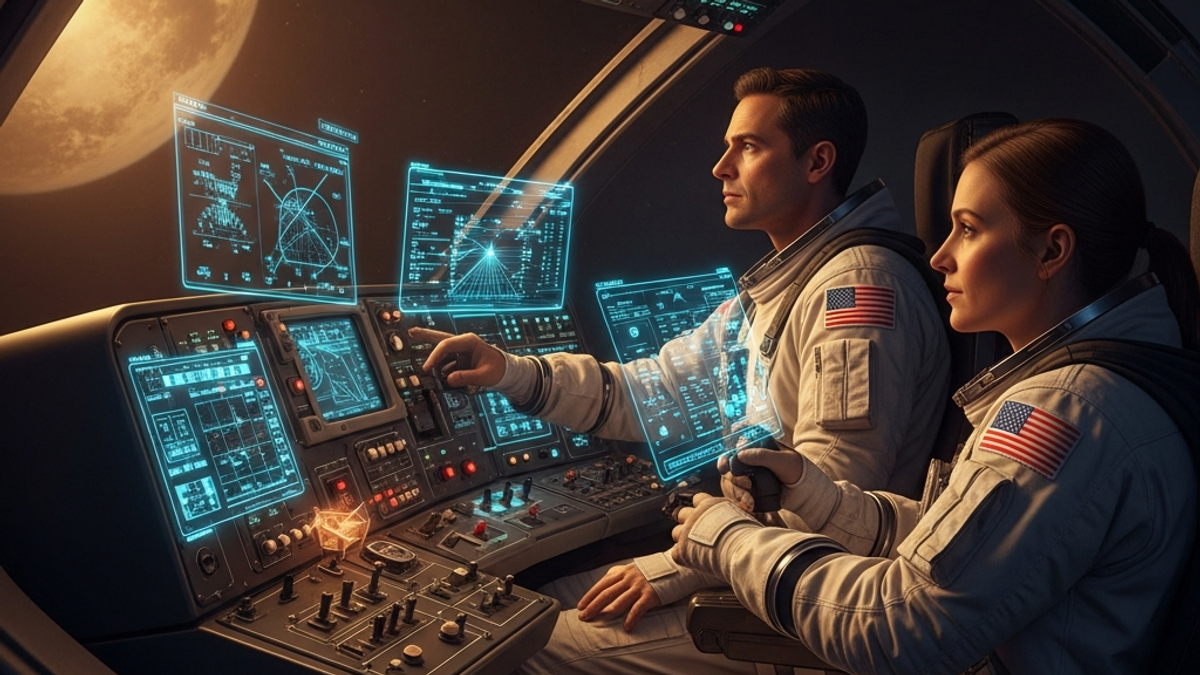
The Artemis II astronauts prepare for their historic lunar flyby through a rigorous, multi-year curriculum that includes intensive simulations of the Orion spacecraft, emergency procedures training, and specialized instruction in orbital mechanics and deep-space navigation [https://www.asc-csa.gc.ca/eng/missions/artemis-ii/training-for-a-mission-to-the-moon.asp]. This comprehensive regimen is essential for ensuring crew safety and mission success, as the crew must master complex onboard systems to handle everything from routine operations to potential in-flight contingencies during their multi-day mission around the Moon [https://www.facebook.com/NASAArtemis/posts/the-artemis-ii-crew-recently-completed-three-days-of-testing-and-training-inside/1057701489870552/].
### What specific simulation activities does the crew perform to master the Orion spacecraft?
To gain operational proficiency, the crew participates in extensive "integrated simulations," which involve working inside high-fidelity mockups of the Orion capsule. These sessions require the astronauts to practice mission-critical tasks, such as manual piloting, systems monitoring, and executing precise maneuvers required for lunar trajectory insertion [https://www.facebook.com/NASAArtemis/posts/the-artemis-ii-crew-recently-completed-three-days-of-testing-and-training-inside/1057701489870552/]. These simulations often include "off-nominal" scenarios, where instructors introduce technical failures to test the crew's ability to diagnose and resolve issues under pressure.
### How are the astronauts prepared for potential emergency situations in deep space?
Emergency preparedness is a cornerstone of the Artemis II training program. Astronauts engage in specialized drills that cover survival in various environments, including emergency egress (rapid exit) from the spacecraft and water survival training in case of an ocean splashdown [https://www.livescience.com/space/space-exploration/artemis-ii-timeline-12-key-steps-that-will-take-nasa-astronauts-to-the-moon-and-back]. Furthermore, they are trained in zero-gravity first aid—including CPR—and the rapid donning of spacesuits, ensuring they can respond effectively to medical or life-support crises while isolated from Earth [https://www.livescience.com/space/space-exploration/artemis-ii-timeline-12-key-steps-that-will-take-nasa-astronauts-to-the-moon-and-back].
### Why is physical and psychological readiness critical for a lunar mission?
Beyond technical skills, the Artemis II crew must maintain peak physical health and mental resilience for the demands of spaceflight. Training includes conditioning for the effects of microgravity on the human body and developing the psychological stamina required for long-duration isolation in a confined space [https://www.asc-csa.gc.ca/eng/missions/artemis-ii/training-for-a-mission-to-the-moon.asp]. This training ensures that the crew can function as a cohesive, high-performing unit, maintaining communication and situational awareness despite the fatigue and psychological stressors inherent in deep-space exploration.
### Key Takeaways
The preparation for Artemis II represents a sophisticated blend of technical mastery and human performance optimization.
* **Integrated Simulations:** Hands-on training in high-fidelity mockups is vital for mastering Orion's complex flight systems.
* **Resilience Training:** Emergency drills, including survival tactics and medical response, prepare the crew for worst-case scenarios.
* **Collaborative Dynamics:** The training focuses heavily on team cohesion to ensure the crew can operate effectively during the nine-day mission.
* **Future Impact:** This mission serves as a "proving ground" for future crewed landings on the Moon and long-term exploration goals, such as missions to Mars, by validating both spacecraft reliability and human physiological responses to deep space.
The Artemis II mission is more than just a flight; it is a culmination of years of meticulous preparation that tests the limits of current spaceflight technology and human adaptability. By rigorously simulating the challenges of lunar travel, NASA ensures that the crew is not only prepared to operate the Orion spacecraft but also ready to return safely to Earth. As we look toward a future of sustained lunar presence, the lessons learned from this training regimen will be fundamental to every subsequent step humanity takes further into our solar system.
## References
* [Training for a mission to the Moon | Canadian Space Agency](https://www.asc-csa.gc.ca/eng/missions/artemis-ii/training-for-a-mission-to-the-moon.asp)
* [The Artemis II crew recently completed three days of testing and training inside their Orion spacecraft | NASA Artemis Facebook](https://www.facebook.com/NASAArtemis/posts/the-artemis-ii-crew-recently-completed-three-days-of-testing-and-training-inside/1057701489870552/)
* [Artemis II timeline: 12 key steps that will take NASA astronauts to the Moon and back | Live Science](https://www.livescience.com/space/space-exploration/artemis-ii-timeline-12-key-steps-that-will-take-nasa-astronauts-to-the-moon-and-back)