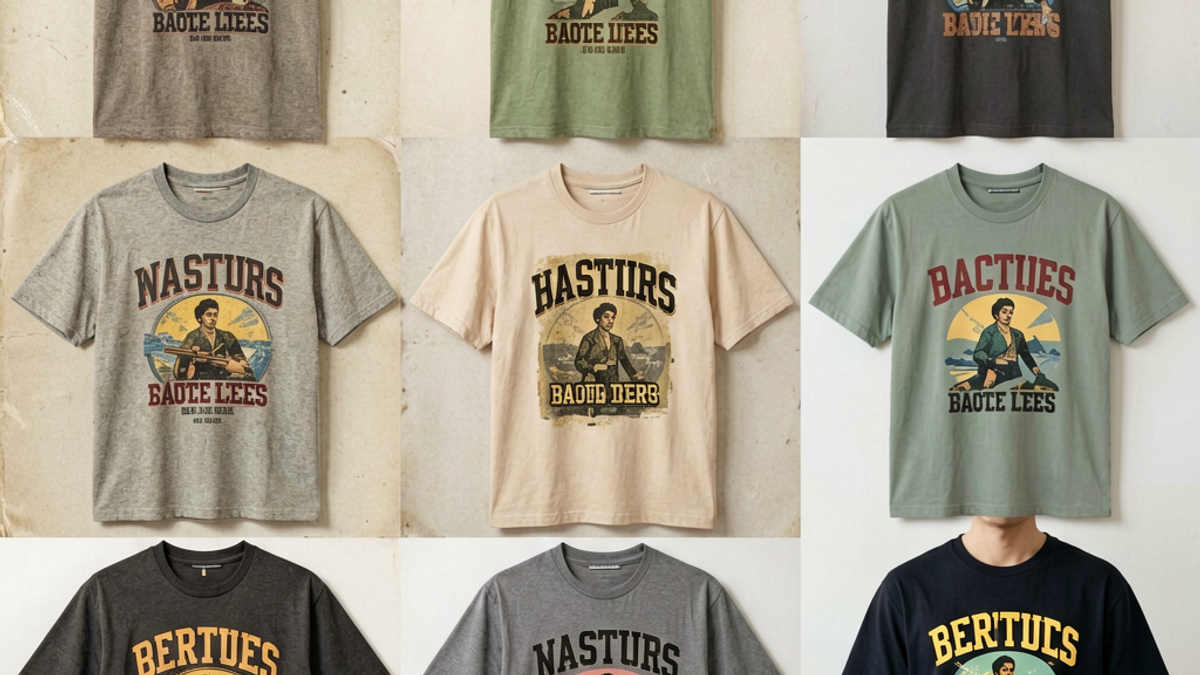
Graphic tees are still trending in 2026 because they remain the cheapest way to declare identity, the easiest entry point into a subculture, and the most flexible canvas for independent designers...
Sylvie Vance
•
Graphic tees are still trending in 2026 because they remain the cheapest way to declare identity, the easiest entry point into a subculture, and the most flexible canvas for independent designers to build brands on. The category has cycled through countless aesthetic phases since the 1960s, and every cycle resets the same way: new tribes form, new designers emerge, and graphic tees become the visible language of those tribes. The trend hasn't ended because the underlying demand — wearable identity — keeps renewing.
Key Takeaways
Identity is the constant demand — graphic tees are the cheapest wearable declaration of who you are.
Independent brands keep the category fresh — each new label brings a new visual vocabulary.
Production economics favor small drops — print-on-demand lets anyone launch a label with one tee.
Social media rewards visible identity — a graphic tee is a low-effort way to be recognized in a feed.
— pop art, skate, anime, hip-hop each cycle in turn.
The trend cycles aesthetics, not the category itself
The Constant Demand: Wearable Identity
People have always wanted to wear what they mean. The medium changes — band merch in the 1970s, punk patches in the 1980s, skate graphics in the 1990s, streetwear codification in the 2000s, niche subculture tees in the 2010s — but the impulse stays the same. A graphic tee says "I am part of this," in a way that a plain tee cannot. As long as humans form tribes and tribes signal through dress, graphic tees will exist.
The demand is also generational. Every new cohort enters the market at fifteen to twenty-five years old and looks for clothing that signals belonging. The specific aesthetic shifts (skate to hip-hop to anime to vintage), but the underlying behavior — buy tees that announce identity — is constant. That generational renewal is what keeps the category structurally durable.
Why the Aesthetic Keeps Cycling
Every 5–8 years, a graphic tee aesthetic cycles back into the main market. Skate graphics dominated the late 90s and early 2000s, faded through the 2010s, and are now back in force with younger buyers who never lived through the original wave. Pop art and Warhol references peaked in the late 2000s and are seeing a quieter resurgence as Y2K aesthetics roll through. Anime and Japanese typography spiked in the late 2010s and remain strong. Vintage collegiate and athletic graphics are in a current cycle. Each cycle is the same pattern: a subculture's visual language becomes mainstream, peaks, fades, then returns with a new generation.
What changes between cycles is the production economics. The 1990s skate graphics were screen-printed in small California shops. The current resurgence of those aesthetics is produced through digital printing, print-on-demand services, and direct-to-consumer Shopify brands. The aesthetic looks similar; the supply chain is completely different. That supply chain shift is what allows each cycle to launch faster than the last — independent designers can produce a drop in weeks instead of months.
Independent Brands and the New Economics
The biggest structural reason graphic tees are still trending is that independent brands can launch faster and cheaper than ever. Print-on-demand services (Printful, Printify, SPOD) let a designer upload a graphic and sell tees without holding inventory. Direct-to-consumer platforms (Shopify, Big Cartel) handle checkout, shipping, and customer service for a fraction of the cost of opening a store. Social media distribution (Instagram, TikTok) lets a brand with no advertising budget reach the right buyers. The barrier to launching a streetwear graphic tee brand has collapsed.
The result is a constant flow of new labels with new visual vocabularies. Some last one drop; some last a decade. But the constant flow means the category never stagnates — every year brings new designers with new perspectives, and buyers get fresh options without waiting for heritage labels to evolve. Stryxen Studio, for example, launched in the current cycle because the production economics made it possible to test a design vocabulary at small scale.
Social Media and Visible Identity
Social media changed what graphic tees are for. In the 1990s and 2000s, a graphic tee was worn in physical contexts — concerts, streets, skate parks, school. Today, a graphic tee is also photographed for digital contexts — Instagram posts, TikTok outfit videos, Pinterest boards. The tee has to read well both in person and in a flat lay or low-resolution feed crop.
That shift has consequences. Print design has simplified — graphics need to read at thumbnail size, which favors bold typography and high-contrast imagery over fine detail. Color palettes have intensified — saturated colors photograph better than muted tones. Branding has moved forward — chest prints that read on a feed beat back prints that only show when turned around. These shifts aren't necessarily good or bad for the category, but they're shaping what "trending" means in 2026.
When the Trend Will End
The graphic tee trend will end when wearable identity stops mattering or when a different medium takes over the role. Neither is on the horizon. Identity signaling is a constant human behavior; no other medium offers the same combination of low cost, high visibility, and personal expression. Holographic AR clothing might shift the medium eventually, but the behavior will outlive the format.
What will change is the aesthetic vocabulary. The current cycle's references will fade, the next cycle's will emerge, and the category will look different every five years while doing the same job. Buyers who anchor to the underlying behavior (wearing identity) instead of the current aesthetic will always find tees worth buying. Buyers who anchor to the current aesthetic will replace their closet every cycle.
What Could Actually Kill the Trend
Speculating about what could end the graphic tee trend is useful because it clarifies what the trend actually depends on. Three scenarios could plausibly slow or end it: a shift in identity signaling toward a different medium, a shift in social media away from visible clothing, or a shift in production economics that makes graphic tees unaffordable. None are imminent, but each is worth understanding.
Identity signaling shift: humans will always want to wear what they mean; the question is which garment carries the signal. Right now it's the graphic tee. A hundred years ago it was the hat. Twenty years from now it could be AR overlays, programmable fabrics, or something we haven't invented. The category survives as long as no competing medium offers a cheaper, more visible identity channel. AR is the most plausible threat — but AR still requires glasses or screens, both of which carry social baggage that graphic tees don't.
Social media shift: the trend is partly amplified by platforms that reward visible identity in photos. If social media shifts toward formats that don't show clothing (audio-first, fully virtual, holographic), the amplification weakens. The trend wouldn't end — identity signaling would just be less visible online. But the category would feel less urgent, and the growth rate would slow.
Production economics shift: a major disruption in global cotton supply, printing capacity, or shipping could raise the cost of graphic tees past the point where independent labels can operate. Cotton prices have been volatile; shipping has been disrupted by recent events; printing capacity is concentrated in specific regions. Any of these could change. But the trend has survived supply shocks before, and the production model is distributed enough to adapt.
The honest forecast: the graphic tee category will continue growing for the next 3–5 years at minimum, supported by structural demand and favorable production economics. Beyond that, the aesthetic will likely cycle and consolidate, with fewer but stronger brands dominating. Buyers who invest now in brands with sustainable design vocabularies will be ahead of the consolidation curve.
The Bottom Line
Graphic tees are still trending because the underlying demand — wearable identity — is constant. The aesthetics cycle every 5–8 years, the production economics keep independent brands launching, and social media amplifies visible identity. The category isn't going anywhere; the specific references will keep rotating. For buyers who want tees built around a visual vocabulary that ages well rather than one that trends and fades, the Stryxen Studio collection treats each drop as a piece of a longer design conversation, not a single-season moment.
Frequently Asked Questions
Why are graphic tees still popular?
Three reasons: identity signaling is a constant human behavior, independent brands can launch cheaper and faster than ever, and social media rewards visible identity. The category isn't going anywhere; the aesthetic references rotate every 5–8 years.
Are graphic tees still trending in 2026?
Yes — the category continues to grow, with current cycles favoring 90s skate references, anime-coded graphics, and vintage athletic aesthetics. New independent brands launch every month, and social media keeps identity-driven clothing in demand.
Will graphic tees ever go out of style?
Unlikely. The category has existed since the 1960s in some form and has survived every trend cycle because it solves a real human need: wearable identity. Aesthetics come and go; the behavior doesn't.
What's the next graphic tee trend after 2026?
Hard to predict specifically, but the pattern is consistent: every cycle lifts a subculture's visual language into the mainstream, peaks, fades, and returns 5–8 years later with a new generation. The current cycle's references will fade; the next is already incubating in niche online communities.
Free Shipping on All OrdersFree ReturnsNo Hidden Fees
 Sylvie Vance