
Where do giant phantom jellyfish typically live in the ocean?
The giant phantom jellyfish primarily lives in the deep ocean's midnight zone, but recent sightings suggest a broader global distribution.
 Sylvie Vance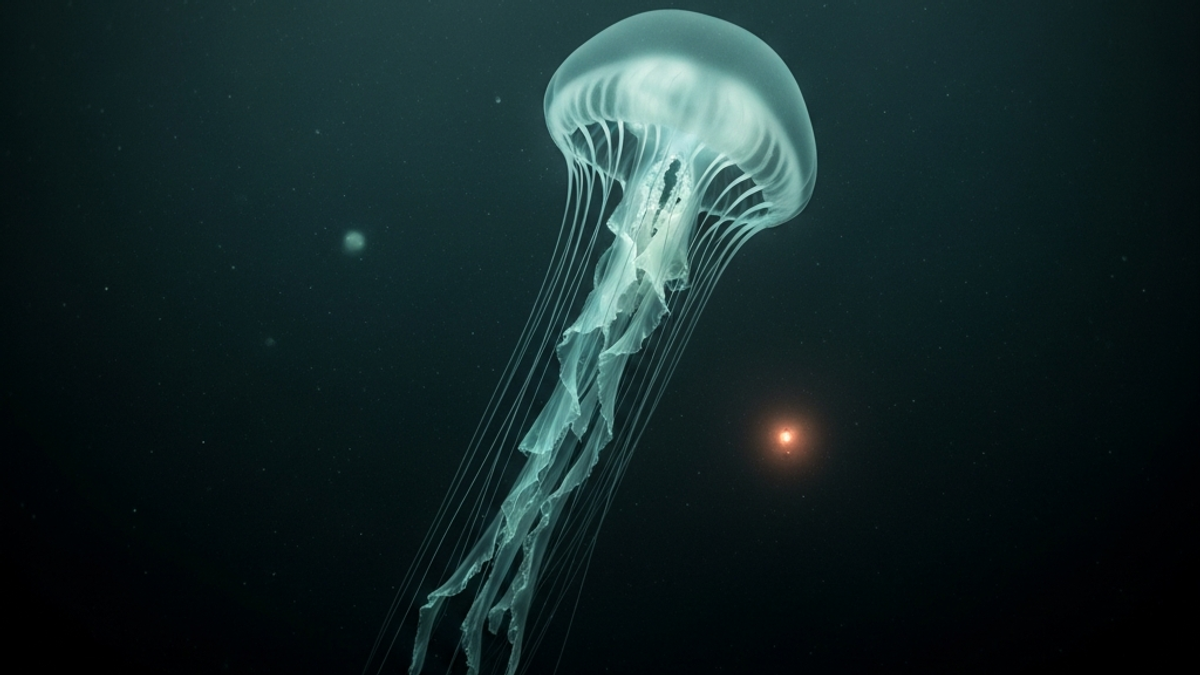
The giant phantom jellyfish (*Stygiomedusa gigantea*) typically lives in the **deep ocean**, primarily inhabiting the bathypelagic or "midnight" zone, which ranges from depths of 1,000 to 4,000 meters (about 3,300 to 13,100 feet) (https://www.mbari.org/animal/giant-phantom-jelly/). Recent sightings, however, have expanded our known observations, including documented encounters off the coast of Argentina in the southern Atlantic Ocean and even in Antarctic Peninsula coastal waters (https://www.fox10phoenix.com/news/rare-giant-phantom-jellyfish-caught-deep-sea-video-off-argentina-coast, https://en.wikipedia.org/wiki/Stygiomedusa). The recent uptick in sightings, even at shallower depths like 830 feet in the Pacific (https://www.popsci.com/environment/giant-phantom-jellyfish-spotted-deep-in-pacific/), highlights a growing ability to observe these massive, elusive creatures, underscoring the vast, unexplored nature of the deep sea.
***
### What defines the habitat of the giant phantom jellyfish, and what are the key zones of observation?
The primary habitat for *Stygiomedusa gigantea* is the **midwater column** in the deep sea, specifically categorized as the bathypelagic zone (https://www.mbari.org/animal/giant-phantom-jelly/). This zone is characterized by perpetual darkness, immense pressure, and cold temperatures, making direct observation exceptionally rare.
While the bathypelagic zone is considered its typical residence, research has documented sightings across a broader vertical range:
* **Mesopelagic and Lower Epipelagic Zones:** Observations have occurred at shallower depths, such as 80–280 meters (262 to 919 feet) around the Antarctic Peninsula (https://en.wikipedia.org/wiki/Stygiomedusa).
* **Southern Atlantic Ocean:** Explorations off Argentina have captured video evidence, suggesting their range spans significant geographical areas (https://www.fox10phoenix.com/news/rare-giant-phantom-jellyfish-caught-deep-sea-video-off-argentina-coast).
* **Pacific Ocean:** Sightings have also been confirmed in the Pacific, often captured by Remotely Operated Vehicles (ROVs) (https://www.popsci.com/environment/giant-phantom-jellyfish-spotted-deep-in-pacific/).
These varying depths show that while they are deep-sea dwellers, their feeding or migratory patterns may bring them into zones slightly higher than the classic midnight zone.
### How does the physical nature of the giant phantom jellyfish influence where it lives?
The physical characteristics of the giant phantom jelly are perfectly adapted to its deep-sea existence, particularly its massive size and unique feeding apparatus (https://en.wikipedia.org/wiki/Stygiomedusa).
1. **Size and Mobility:** With bells up to 3.3 feet in diameter and ribbon-like oral arms that can extend up to 33 feet long, the jellyfish is one of the largest known invertebrate predators in the deep sea (https://www.fox10phoenix.com/news/rare-giant-phantom-jellyfish-caught-deep-sea-video-off-argentina-coast). This size requires a vast, relatively stable environment found in the deep pelagic zones, as surface waters are too dynamic.
2. **Lack of Stinging Tentacles:** Unlike many jellyfish, *S. gigantea* lacks long, stinging tentacles. Instead, it uses its thick, muscular arms to capture prey (https://www.fox10phoenix.com/news/rare-giant-phantom-jellyfish-caught-deep-sea-video-off-argentina-coast). This morphology is well-suited for sweeping through the sparse food matter available in the deep water column, targeting plankton and small fish (https://en.wikipedia.org/wiki/Stygiomedusa).
Its adaptations suggest a reliance on a food source that is somewhat consistently available in the bathypelagic zone, though what it specifically preys on in such low-density environments remains an area of ongoing study.
### What makes studying the distribution of this species so challenging?
Studying the distribution of the giant phantom jelly is difficult due to the extreme conditions of its primary habitat, which requires highly specialized equipment and limited research windows.
* **Depth Limitations:** Reaching the bathypelagic zone requires submersibles or ROVs capable of withstanding crushing pressures, limiting the amount of time researchers can spend searching (https://www.mbari.org/animal/giant-phantom-jelly/).
* **Rarity of Encounter:** The species is infrequently observed. A study referenced by Wikipedia noted that the overall number of documented sightings is very low, making it difficult to map a comprehensive range (https://en.wikipedia.org/wiki/Stygiomedusa).
* **Technology Dependence:** Encounters rely heavily on deep-sea exploration missions, like those conducted by the Schmidt Ocean Institute, which are expensive and intermittent (https://www.fox10phoenix.com/news/rare-giant-phantom-jellyfish-caught-deep-sea-video-off-argentina-coast).
Because most observations are opportunistic video recordings, researchers often extrapolate distribution based on where the technology successfully operated, rather than a dedicated species survey.
### Why have recent sightings, even outside the expected range, generated such interest?
Recent sightings of the giant phantom jelly outside its assumed core habitat—especially in areas like the Antarctic—generate significant scientific and public interest because they challenge current biogeographical models of deep-sea life (https://www.facebook.com/cnn/posts/scientists-off-the-coast-of-argentina-found-a-rare-giant-phantom-jelly-820-feet-/1277134027612579/).
When the species is spotted in Antarctic waters, where it is generally not considered native, it forces scientists to re-evaluate the connectivity and tolerance levels of deep-sea fauna (https://en.wikipedia.org/wiki/Stygiomedusa). Furthermore, any confirmed, high-quality video of such a massive, rare creature—like those filmed by ROVs—provides invaluable behavioral and morphological data that cannot be gathered from preserved specimens alone. These events serve as powerful reminders of how little we know about the majority of our planet’s volume: the deep ocean.
***
## Key Takeaways: Understanding the Giant Phantom Jelly Habitat
* **Primary Residence:** The giant phantom jellyfish predominantly occupies the bathypelagic ("midnight") zone, thousands of feet below the surface (https://www.mbari.org/animal/giant-phantom-jelly/).
* **Observed Range Expansion:** Recent deep-sea explorations have confirmed their presence in geographically diverse areas, including the South Atlantic off Argentina and near the Antarctic Peninsula, suggesting a wider global distribution than previously mapped (https://www.fox10phoenix.com/news/rare-giant-phantom-jellyfish-caught-deep-sea-video-off-argentina-coast).
* **Adaptation to Darkness:** Its massive size and specialized oral arms, used to sweep for small fish and plankton, are adaptations for surviving in the low-resource, high-pressure environment of the deep sea (https://en.wikipedia.org/wiki/Stygiomedusa).
* **Research Hurdle:** Studying its true distribution is hampered by the high cost, technical difficulty, and short duration of deep-sea submersible missions required for observation (https://www.popsci.com/environment/giant-phantom-jellyfish-spotted-deep-in-pacific/).
The future of research into *Stygiomedusa gigantea* is intrinsically linked to advancements in deep-sea vehicle technology. As ROVs become more capable of longer, more frequent dives into the midnight zone, our understanding of this giant's true geographic range and ecological role is set to expand dramatically, potentially revealing entirely new deep-sea ecosystems.
## Conclusion
The question of where the giant phantom jellyfish lives leads us not to a single, static location, but to the vast, dark expanse of the world’s deep ocean layers. While the bathypelagic zone remains its fortress, sporadic, high-profile sightings confirm that this magnificent, ghostly creature traverses immense, interconnected oceanic regions. Every successful observation serves as critical, evidence-based data that slowly fills in the gaps of our deep-sea map. The very difficulty in studying *S. gigantea* underscores a fundamental truth in marine biology: the largest frontier for discovery remains right here on Earth, miles beneath the waves.
## References
* https://www.mbari.org/animal/giant-phantom-jelly/
* https://www.fox10phoenix.com/news/rare-giant-phantom-jellyfish-caught-deep-sea-video-off-argentina-coast
* https://www.popsci.com/environment/giant-phantom-jellyfish-spotted-deep-in-pacific/
* https://en.wikipedia.org/wiki/Stygiomedusa
* https://www.facebook.com/cnn/posts/scientists-off-the-coast-of-argentina-found-a-rare-giant-phantom-jelly-820-feet-/1277134027612579/