
What exactly does "no kings protest" mean?
The 'No Kings Protest' is a decentralized movement that argues against perceived antidemocratic executive power by invoking foundational American republican principles.
 Sylvie Vance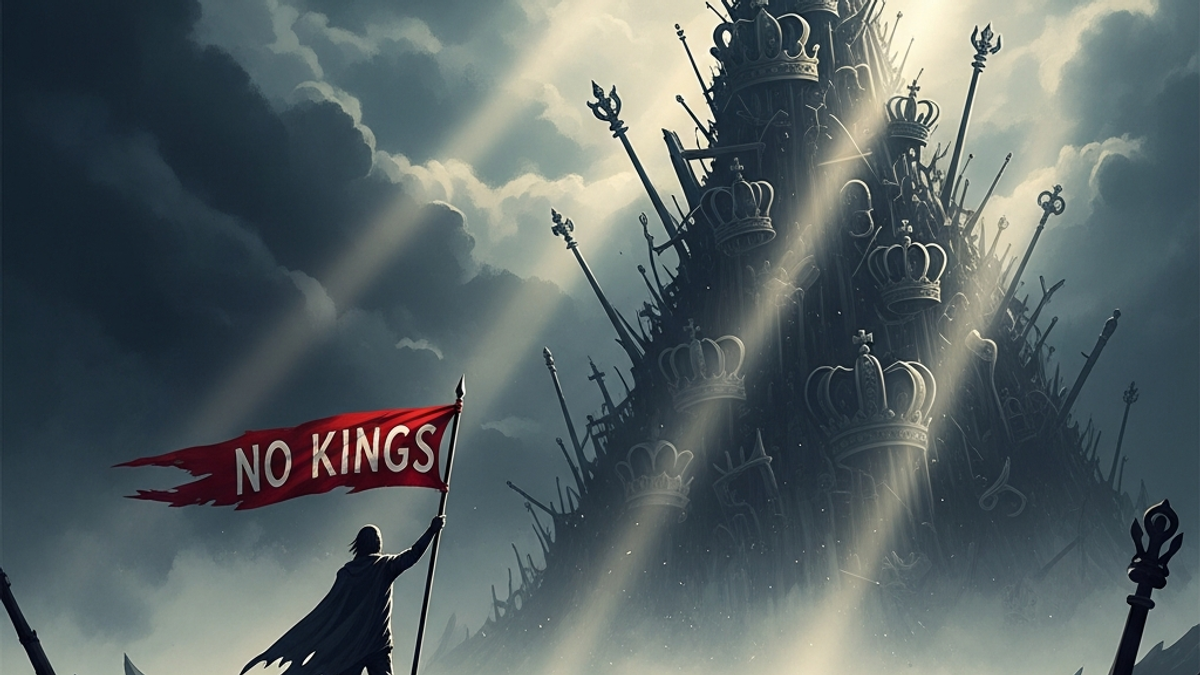
The "No Kings Protest" is a nationwide, decentralized political demonstration movement organized to explicitly reject what participants view as antidemocratic or monarchical tendencies in a sitting U.S. President, asserting that America belongs to its citizens and has no kings (https://www.nokings.org/about-nk). These protests were specifically framed to counter the administration's policies and perceived attempts to centralize power, often being timed to coincide with significant political dates or events, such as the President's birthday or national celebrations (https://www.pbs.org/newshour/politics/what-to-know-about-no-kings-protests-against-trumps-policies). The movement gained significant traction, with organizers claiming mobilization of millions across thousands of events nationwide (https://www.nokings.org/about-nk).
## What is the historical and philosophical origin of the "No Kings" slogan?
The core philosophy behind the "No Kings" slogan is rooted in the foundational democratic principle that the United States is a republic governed by the consent of the governed, not by a sovereign monarch. The slogan serves as a direct rebuke to any perceived authoritarian overreach, referencing the historical context of the American Revolution against monarchy (https://www.britannica.com/event/No-Kings-protests). Protesters use this terminology to signal their rejection of executive actions they deem to be above constitutional scrutiny or the will of the people, effectively calling for the President to operate strictly within the established democratic framework (https://www.pbs.org/newshour/politics/what-to-know-about-no-kings-protests-against-trumps-policies).
### How large-scale were the "No Kings" demonstrations, and where did they take place?
The "No Kings" demonstrations were characterized by their significant scale and widespread national presence. Organizers have publicized figures suggesting massive turnout, claiming that one key event mobilized over seven million Americans across more than 2,700 separate events spanning all 50 states (https://www.nokings.org/about-nk). This scale was strategically organized to demonstrate the breadth of resistance, moving beyond traditional centers of protest into smaller towns and diverse communities (https://www.britannica.com/event/No-Kings-protests). The movement aimed to be a sustained national resistance rather than a single-day event, aiming for continuous mobilization (https://www.nokings.org/about-nk).
### What specific actions or policies motivated the organizers of the protests?
The motivations for the "No Kings" protests have been explicitly tied to specific actions taken by the administration they were protesting, including critiques of immigration crackdowns, federal law enforcement deployments, and perceived ego-driven displays of power (https://www.pbs.org/newshour/politics/what-to-know-about-no-kings-protests-against-trumps-policies). For instance, in some instances, protests were organized in response to the deployment of the National Guard to cities experiencing unrest, which opponents interpreted as an escalation toward authoritarian control (https://www.britannica.com/event/No-Kings-protests). The very timing of protests, sometimes coinciding with the President's birthday or national military celebrations, was a deliberate act to redirect focus toward democratic principles (https://www.pbs.org/newshour/politics/what-to-know-about-no-kings-protests-against-trumps-policies).
### What is the intended impact of framing political opposition as a fight against a "King"?
Framing the political opposition as a fight against a "King" is a powerful rhetorical strategy intended to galvanize public sentiment by appealing to deep-seated American anti-monarchical sentiment (https://www.nokings.org/about-nk). This language serves to delegitimize the target leader by positioning their actions as fundamentally incompatible with democratic governance (https://www.britannica.com/event/No-Kings-protests). The intent is to mobilize citizens around the defense of constitutional order rather than specific policy disagreements, making the resistance appear as a necessary defense of the republic itself (https://www.pbs.org/newshour/politics/what-to-know-about-no-kings-protests-against-trumps-policies).
## Key Takeaways: Analyzing the "No Kings" Movement
Understanding the "No Kings Protest" movement requires recognizing its strategic messaging and organizational reach:
* **Core Message:** The movement fundamentally rejects any perceived monarchical or antidemocratic behavior by executive leadership, asserting popular sovereignty.
* **Scale and Scope:** It was intended to be a massive, decentralized national resistance, organized across all 50 states with claims of millions of participants.
* **Rhetorical Power:** The term "No Kings" is a potent appeal to foundational American identity and opposition to tyranny.
* **Motivation:** Protests were typically triggered by specific executive actions—such as immigration enforcement or perceived attempts to use national symbols for personal aggrandizement—that organizers felt subverted democratic norms.
The future impact of such movements lies in their ability to sustain pressure and define the terms of political debate around executive power and democratic norms.
In conclusion, the "No Kings Protest" is far more than a simple demonstration; it represents a significant, organized effort to anchor public discourse back to the bedrock principles of American republicanism. By drawing a sharp contrast between democratic leadership and monarchical rule, participants sought to challenge the legitimacy of executive actions perceived as exceeding constitutional bounds. As political polarization continues, understanding the language and mobilization tactics of movements like "No Kings" is crucial for analyzing the evolving state of civic engagement and democratic resilience in the United States.
## References
* https://www.nokings.org/about-nk
* https://www.britannica.com/event/No-Kings-protests
* https://www.pbs.org/newshour/politics/what-to-know-about-no-kings-protests-against-trumps-policies