How long will the Artemis II mission be in space?
The NASA Artemis II mission is a ten-day crewed flight using a free-return trajectory to test life-support systems, paving the way for future lunar landings.
 Sylvie Vance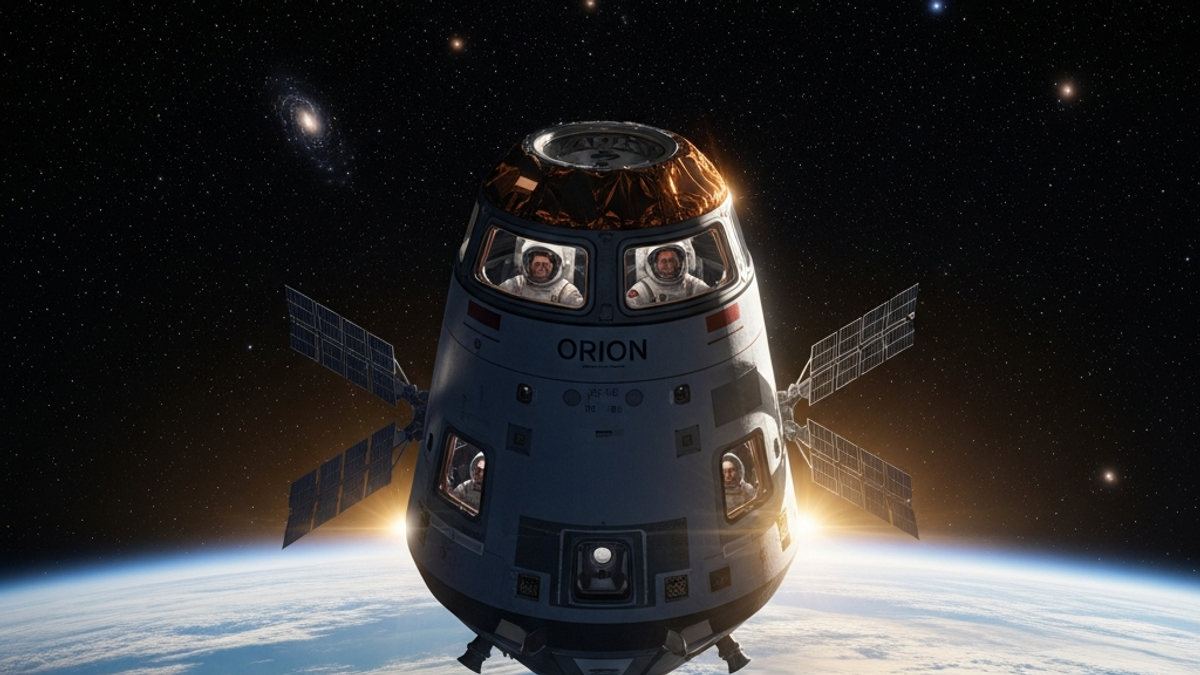
The Artemis II mission is planned to be an approximately 10-day flight, during which the crewed Orion spacecraft will travel on a free-return trajectory around the Moon before returning to Earth for a splashdown in the Pacific Ocean (https://www.usatoday.com/story/news/nation/2026/04/01/how-long-will-it-take-artemis-ii-moon-timeline/89428379007/). As the first crewed mission of NASA’s Artemis program, this flight serves as a critical test of the life-support, communication, and navigation systems required to eventually sustain a human presence on the lunar surface and beyond.
### What are the main objectives of the 10-day mission?
The primary goal of Artemis II is to demonstrate that the Orion spacecraft’s systems—including life support, propulsion, and thermal controls—are safe for human crews deep in space. During the first one to two days, the astronauts will remain in a high Earth orbit to conduct rigorous systems checks (https://www.usatoday.com/story/news/nation/2026/04/01/how-long-will-it-take-artemis-ii-moon-timeline/89428379007/). Following these checks, the craft will perform a translunar injection burn to head toward the Moon, ultimately completing a single lunar flyby before beginning the journey home (https://spacenews.com/artemis-2s-nearly-10-day-flight-around-the-moon/).
### Why will the spacecraft not enter lunar orbit?
Unlike the Apollo missions, which orbited the Moon multiple times to survey landing sites, the Artemis II mission is designed to follow a "free-return trajectory." This specific flight path allows the spacecraft to loop around the Moon and use lunar gravity to slingshot back toward Earth without the need for a complex lunar orbit insertion burn (https://www.usatoday.com/story/news/nation/2026/04/01/how-long-will-it-take-artemis-ii-moon-timeline/89428379007/). This approach maximizes mission safety by ensuring the spacecraft remains on a path that naturally returns it to Earth.
### How does Artemis II prepare us for future Moon landings?
Artemis II acts as a bridge between the uncrewed Artemis I mission and the future Artemis III mission, which aims to return humans to the lunar surface. By validating the performance of the Orion capsule with a human crew on board, NASA gains the necessary experience to proceed with more complex operations, such as docking in orbit and lunar landings (https://www.planetary.org/articles/artemis-ii-what-to-expect). Every day of the 10-day mission is packed with evaluations of how the spacecraft and its systems handle the unique environment of deep space.
### Key Takeaways
* **Mission Duration:** Artemis II is scheduled as a roughly 10-day mission.
* **Trajectory:** The crew will complete a "free-return" flight, looping around the Moon rather than staying in lunar orbit.
* **System Validation:** The flight is essential for testing life-support and communications systems that were not fully stress-tested during uncrewed flights.
* **Program Milestone:** Success here paves the way for the Artemis III landing mission, which intends to put the next humans on the Moon.
Looking ahead, the successful completion of Artemis II will mark a monumental shift in human spaceflight. By proving our capability to keep humans alive and working in deep space for over a week, NASA sets the stage for a sustainable lunar economy and eventually, missions to Mars.
The Artemis II mission represents not just a return to the Moon, but the expansion of humanity's reach into the solar system. As we prepare to take these next steps, the data gathered during these 10 days will be the foundation upon which our future in space is built. Are we ready for the challenges that come with living and working further from Earth than ever before?
## References
* [How long will it take Artemis II to get to the moon? (USA Today)](https://www.usatoday.com/story/news/nation/2026/04/01/how-long-will-it-take-artemis-ii-moon-timeline/89428379007/)
* [Artemis 2's (nearly) 10-day flight around the moon (SpaceNews)](https://spacenews.com/artemis-2s-nearly-10-day-flight-around-the-moon/)
* [Artemis II mission: What to expect (The Planetary Society)](https://www.planetary.org/articles/artemis-ii-what-to-expect)