What does the giant phantom jellyfish look like?
The Giant Phantom Jellyfish is a colossal, deep-sea predator defined by its massive bell and extremely long, ribbon-like oral arms.
 Sylvie Vance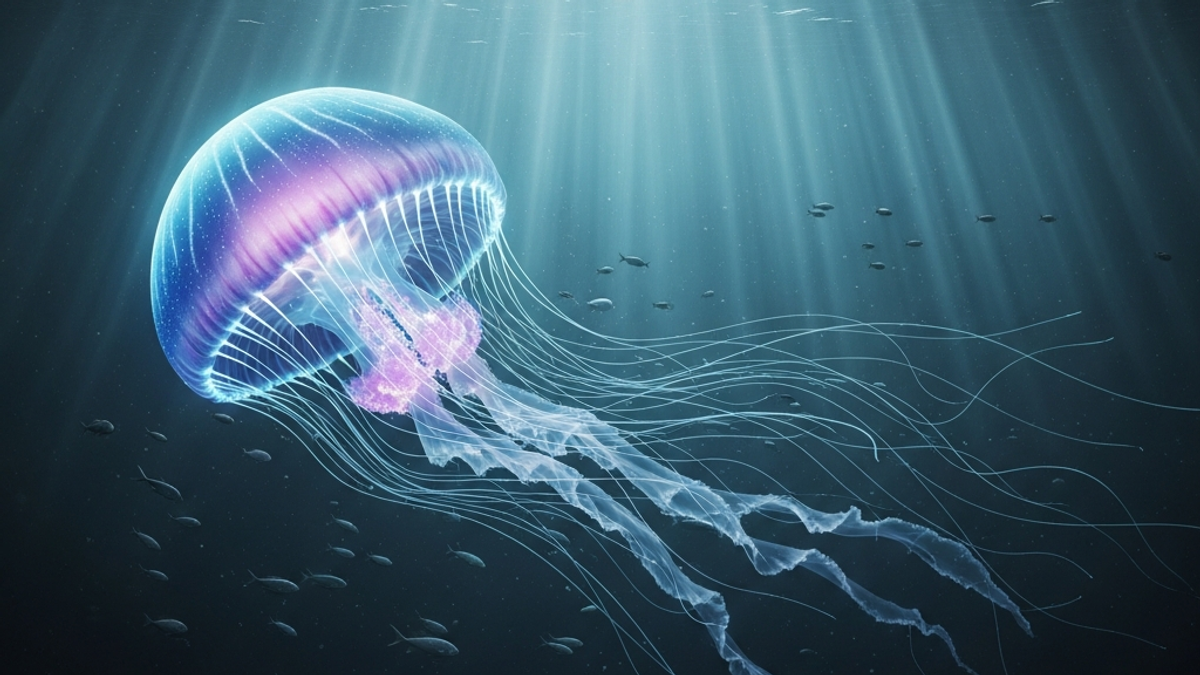
The Giant Phantom Jellyfish (*Stygiomedusa gigantea*) looks like a ghostly, ethereal giant characterized by a massive, reddish-brown bell, which can reach over one meter (3.3 feet) in diameter, trailing four distinctive, long, ribbon-like oral arms that can extend up to 10 meters (33 feet) in length, distinguishing it from other jellies whose tentacles often dangle or coil (MBARI, 2021). This striking, colossal appearance solidifies its status as one of the largest invertebrate predators in the deep sea, sparking awe with every rare sighting.
### How large is the Giant Phantom Jellyfish, and what are its most distinctive physical features?
The sheer scale of the *Stygiomedusa gigantea* is one of its most defining traits, leading to its common name. Its bell, or umbrella, is robust and shaped somewhat like an umbrella, capable of achieving a diameter exceeding 1 meter (3.3 feet) (MBARI, 2021). However, the most spectrally distinct features are its four oral arms—often described as paddle-like or kite-like—which are incredibly long, trailing behind the main body. While the bell is substantial, these oral arms can extend over 10 meters (33 feet) in length (MBARI, 2021). Furthermore, the entire organism often possesses a deep reddish-brown or purplish hue, which serves as camouflage in the dim light of the deep ocean (Megaquarium, n.d.). Unlike many shallower jellyfish, the Giant Phantom Jellyfish lacks the stinging, trailing tentacles typical of its relatives; instead, its oral arms are used for feeding.
### Why is the Giant Phantom Jellyfish so rarely seen by scientists?
The Giant Phantom Jellyfish is rarely encountered due to its deep-sea habitat. It resides in the bathypelagic zone, often found at depths ranging from 80 to 2,800 meters (roughly 260 to 9,200 feet) (Wikipedia, n.d.). This extreme depth makes direct observation exceptionally challenging. Historically, scientists relied on trawl nets, but these nets typically destroy the delicate gelatinous structure of jellyfish, turning specimens into "gelatinous goo" (MBARI, 2021). Modern scientific encounters have become possible almost exclusively through the deployment of Remotely Operated Vehicles (ROVs) equipped with high-definition cameras, which allow researchers to study the animal intact in its natural environment (MBARI, 2021). Despite having been known since 1899 and documented across all major ocean basins except the Arctic, the total number of confirmed sightings remains low, with scientists logging the species only about 100 times in over a century (MBARI, 2021).
### What is known about the diet and ecological role of this deep-sea predator?
As a large invertebrate predator in the deep sea, the Giant Phantom Jellyfish plays a significant, though somewhat mysterious, ecological role. Its primary method of feeding involves using its massive oral arms to capture prey. Its typical diet consists of plankton and small fish drifting in the water column (Wikipedia, n.d.). Researchers believe the extensive, trailing oral arms act as a vast net, sweeping up smaller organisms before directing them to the centrally located mouth on the underside of the bell. Its wide geographic distribution, having been observed globally, suggests it is a widespread component of deep-sea food webs, even if its infrequency of sightings makes quantifying its exact biomass impact difficult.
### How does the observation of this species benefit deep-sea science?
The rare but successful observation of the *Stygiomedusa gigantea* using advanced ROV technology is crucial for deep-sea biology. These high-definition video captures allow scientists to study the animal's morphology, behavior, and physical integrity in a way that preserved specimens never could (MBARI, 2021). For instance, studying the intact structure of the oral arms helps researchers hypothesize more accurately about its feeding mechanisms. Moreover, each sighting helps map the species’ true global distribution, challenging assumptions based on limited trawl data and showcasing the effectiveness of modern, non-invasive deep-sea exploration tools (MBARI, 2021).
## Key Takeaways
* **Colossal Appearance:** The Giant Phantom Jellyfish is defined by its large, reddish bell (over 1 meter wide) and its four extremely long, ribbon-like oral arms that can exceed 10 meters.
* **Deep Habitat:** It is a true deep-sea dweller, typically residing in depths where sunlight cannot penetrate, which is the primary reason for its scarcity.
* **Non-Invasive Study:** Our understanding of this rare species has dramatically improved thanks to the use of ROVs, which preserve the animal’s structure during observation, unlike traditional trawling methods.
* **Global Presence:** Despite being rarely seen, the species has a documented worldwide distribution across most ocean basins, indicating it is a foundational, albeit elusive, deep-sea predator.
The ongoing documentation of creatures like the Giant Phantom Jellyfish underscores how much of Earth’s biosphere remains unexplored. As technology continues to push the boundaries of ocean depth accessibility, these ghostly giants serve as a profound reminder of the bizarre, beautiful, and massive life forms thriving far beyond the reach of the sun.
## References
* MBARI. (2021). *An extraordinary deep-sea sighting: The giant phantom jelly*. [YouTube Video]. Retrieved from https://www.youtube.com/watch?v=9bzQYKm3xTA
* Megaquarium. (n.d.). *Giant Phantom Jelly*. Megaquarium Wiki. Retrieved from https://megaquarium.fandom.com/wiki/Giant_Phantom_Jelly
* Wikipedia. (n.d.). *Stygiomedusa*. Retrieved from https://en.wikipedia.org/wiki/Stygiomedusa