Why are Rosa Parks and Jackie Robinson trending together right now?
Parks and Robinson trend together as symbols of Civil Rights resistance, contrasting grassroots action with pioneering institutional change.
 Sylvie Vance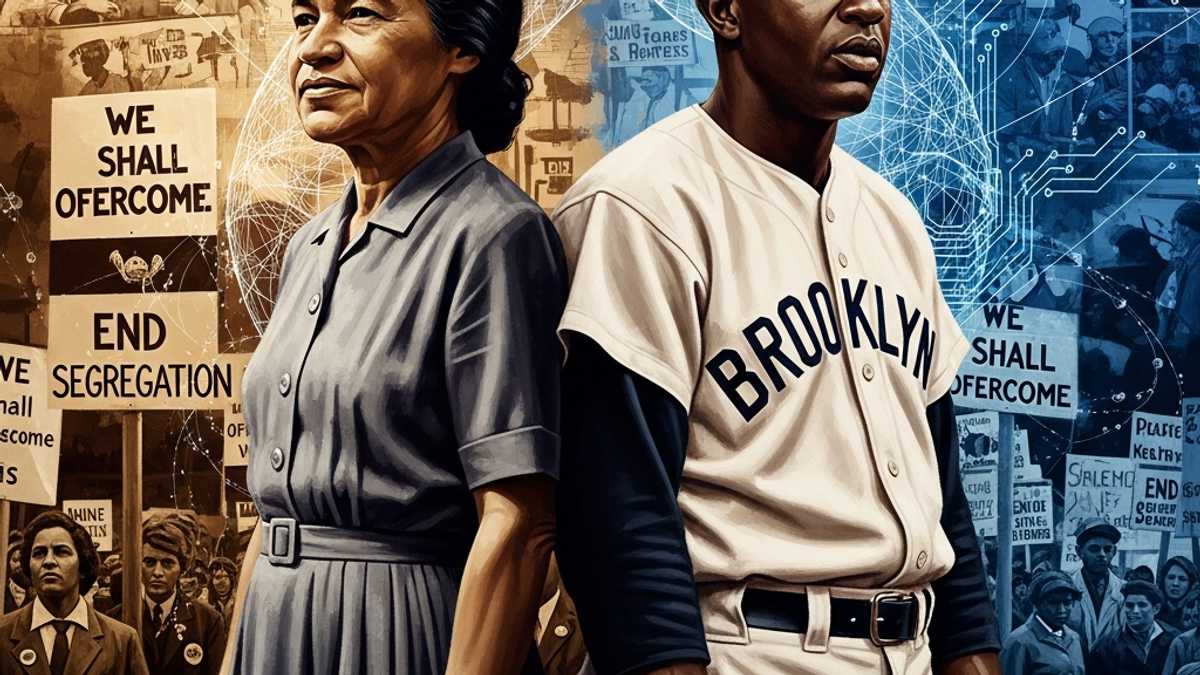
Rosa Parks and Jackie Robinson are frequently trending or discussed in tandem because they represent two distinct, yet critically linked, fronts of the American Civil Rights Movement—the public dismantling of segregation in sports (Robinson) and the strategic, non-violent direct action against public accommodation laws (Parks) (https://www.forbes.com/sites/terencemoore/2025/03/22/dont-be-shocked-if-mlb-strikes-out-jackie-robinson-day-with-dei-fastball/). Their continued relevance stems from ongoing educational initiatives, historical retrospectives often tied to Black History Month, and contemporary debates over equity, where both figures serve as foundational benchmarks for courage against systemic racism.
### What specific historical contexts link the non-violent resistance of Jackie Robinson and Rosa Parks?
The primary historical link between Jackie Robinson and Rosa Parks lies in their shared role in challenging the deeply entrenched system of Jim Crow segregation in the mid-20th century, though their methods and arenas differed. Robinson integrated Major League Baseball starting in 1947, facing intense psychological and physical hostility as he broke baseball's color barrier (https://catalog.chattlibrary.org/Search/Results?lookfor=%22Race+relations.%22&searchIndex=Subject&filter[]=rating_facet%3A%22Unrated%22&filter[]=available_at%3A%22South+Chattanooga+Branch%22&sort=days_since_added+asc&view=list&searchSource=local). This act was a highly visible, high-stakes endeavor that demanded disciplined, non-retaliatory behavior—a form of resistance that set a precedent for public composure under duress. Parks’s act, which occurred eight years later in 1955, was a strategic, quiet refusal to comply with bus segregation laws in Montgomery, Alabama, which then catalyzed the Montgomery Bus Boycott (https://catalog.pascolibraries.org/Search/Results?lookfor=%22Segregation.%22&searchIndex=Subject&sort=relevance&page=%d&view=list&searchSource=local&page=3). Both demonstrated profound moral fortitude under hostile conditions, making them parallel symbols of resistance against the same oppressive legal structure.
### How does the modern discussion of their legacies compare, given Robinson's public breaking of barriers versus Parks's strategically planned act?
Modern analysis often contrasts the *visibility* and *nature* of their struggles. Jackie Robinson’s integration was a high-profile, nationally televised, and sustained performance that involved challenging segregation within a professional, structured environment. His legacy is often framed around **leadership, endurance, and breaking systemic barriers through established (albeit discriminatory) institutions.** Conversely, Rosa Parks's refusal is often framed as an **everyday act of defiance** by an ordinary citizen, though research confirms it was a calculated move by activists (https://catalog.chattlibrary.org/Search/Results?lookfor=%22Race+relations.%22&searchIndex=Subject&filter[]=rating_facet%3A%22Unrated%22&filter[]=available_at%3A%22South+Chattanooga+Branch%22&sort=days_since_added+asc&view=list&searchSource=local). When these figures trend together, commentators frequently use Robinson to discuss the pressures of being a "first"—the singular representative—and Parks to discuss the power of collective, grassroots mobilization. Recent discussions have also noted that Robinson’s struggles extended well beyond baseball, forcing a re-evaluation of him as a complex political figure, not just an athlete (https://www.fwps.org/story/~board/news/post/black-history-month-2024).
### What contemporary social or political events might be causing a renewed focus on these two figures simultaneously?
When figures like Parks and Robinson trend outside of established heritage months (like February's Black History Month), it is almost always catalyzed by current events related to civil rights, voting rights, or equity debates in areas like education or sports. For instance, discussions surrounding Critical Race Theory (CRT) in schools or debates over Diversity, Equity, and Inclusion (DEI) initiatives often invoke historical precedents. When DEI policies face political challenges, activists and historians may naturally invoke Robinson as a prime example of historical integration success and Parks as an example of direct action success to defend the importance of equity efforts (https://www.forbes.com/sites/terencemoore/2025/03/22/dont-be-shocked-if-mlb-strikes-out-jackie-robinson-day-with-dei-fastball/). Furthermore, any major political anniversary or the release of new historical documentation about the Civil Rights Era can prompt a comparative look at these two monumental figures simultaneously.
### What specific lessons from their careers can be applied to current social justice and equity movements?
The enduring lessons drawn from Parks and Robinson are highly applicable to contemporary activism. From Robinson, movements can take the lesson of **strategic patience and sustained excellence**—that success requires not only challenging the rules but also performing at an impeccable level to deny critics grounds for exclusion. From Parks, the lesson is the **power of strategic disruption and the mobilization potential inherent in everyday citizenry**; her action proved that deeply ingrained, seemingly mundane rules of segregation could be defeated through unified, principled refusal (https://catalog.pascolibraries.org/Search/Results?lookfor=%22Segregation.%22&searchIndex=Subject&sort=relevance&page=%d&view=list&searchSource=local&page=3). Both figures underscore that meaningful systemic change often requires both highly visible pioneers and widespread grassroots commitment.
**4. Key Takeaways & Future Outlook**
**Key Takeaways: Understanding the Parallel Legacies**
* **Shared Goal, Different Arenas:** Both figures fundamentally challenged segregation, Robinson in professional sports and Parks in public transit, making them two sides of the same historical coin.
* **Methodological Contrast:** Robinson demonstrated resilience under high-pressure, professional scrutiny, while Parks catalyzed mass mobilization through a singular act of non-compliance.
* **Relevance Drivers:** Their simultaneous trending is often linked to contemporary political debates surrounding equity initiatives or historical commemorations where their distinct forms of resistance provide useful historical parallels.
* **Enduring Value:** Their stories remain essential primers for understanding that systemic change requires both institutional breakthroughs and widespread civic action.
The future of their relevance is secure as long as the principles they fought for—equality of access and inherent human dignity—remain subjects of national conversation. As educational curricula evolve and new historical lenses are applied, expect continued analysis that digs deeper into the nuances of their activism, moving beyond simple iconography toward a more complex, evidence-based understanding of their roles.
**5. Conclusion**
The simultaneous resonance of Jackie Robinson and Rosa Parks in the modern discourse is less about a singular, recent event and more about their established, vital placement in the American historical narrative. They anchor two essential archetypes of civil rights struggle: the visible barrier-breaker and the courageous catalyst of grassroots protest. By examining why their legacies converge, we gain a richer, more holistic appreciation for the multifaceted effort required to dismantle systemic injustice, reinforcing that true progress demands both singular bravery and collective will.
## References
* https://www.forbes.com/sites/terencemoore/2025/03/22/dont-be-shocked-if-mlb-strikes-out-jackie-robinson-day-with-dei-fastball/
* https://catalog.chattlibrary.org/Search/Results?lookfor=%22Race+relations.%22&searchIndex=Subject&filter[]=rating_facet%3A%22Unrated%22&filter[]=available_at%3A%22South+Chattanooga+Branch%22&sort=days_since_added+asc&view=list&searchSource=local
* https://catalog.pascolibraries.org/Search/Results?lookfor=%22Segregation.%22&searchIndex=Subject&sort=relevance&page=%d&view=list&searchSource=local&page=3
* https://www.fwps.org/story/~board/news/post/black-history-month-2024