Total Solar Eclipse Aug 12, 2026 — How the Path of Totality Becomes a Graphic Tee Capsule (and What Independent Labels Should Actually Drop)
A rare total solar eclipse crosses Greenland, Iceland and northern Spain on Wednesday, August 12, 2026, with a deep partial — typically 40 to 90 percent obscuration — visible across 26 US states...
Sylvie Vance
•
A rare total solar eclipse crosses Greenland, Iceland and northern Spain on Wednesday, August 12, 2026, with a deep partial — typically 40 to 90 percent obscuration — visible across 26 US states from the mid-Atlantic through the Midwest (Forbes, Space.com, EarthSky, August 2026). The eclipse lands inside the Perseid meteor shower's peak, which doubles the window for a celestial-event capsule and turns the path-of-totality silhouette into the cleanest single-icon graphic-tee drop of the 2026 calendar. Independent labels have roughly 48 hours between the US partial peak and the Perseid tail to make it land.
What the August 12 2026 total solar eclipse actually is
The August 12, 2026 total solar eclipse is the first total anywhere on Earth since the April 8, 2024 North American total, and the first to cross European landmass since the August 11, 1999 event. The path of totality sweeps across central Greenland, slices through Iceland between roughly 18:45 and 19:15 local time, and crosses northern Spain from Bilbao through Zaragoza to Valencia between roughly 20:25 and 21:00 local time. Outside that ribbon, observers across the UK, Ireland, France, Portugal, the Netherlands and 26 US states see a deep partial, with obscuration peaking between 40 percent on the East Coast and 90 percent in the upper Midwest.
The geographic split is the streetwear story. European totality viewers are concentrated in Reykjavík, Bilbao and Valencia, cities that already stock indie graphic apparel at scale. The US partial band runs from Boston and New York westward through Cleveland, Detroit, Indianapolis, St. Louis and into the Plains. The Perseid meteor shower peaks the same night, which means a capsule that lands in that 24-hour window gets two cultural moments for one shipping cycle.
Why the 2024 total set the playbook this drop inherits
The April 8, 2024 total solar eclipse was the largest single-event apparel spike in modern streetwear history. NASA and JPL ran a limited capsule with Vans. National Geographic partnered with REI on a path-of-totality print series. Uniqlo UT dropped a UTme! eclipse tee capsule that sold out within 48 hours, and state-park gift shops along the totality path sold path-map tees that, in several cases, became that park's bestselling apparel SKU of the year.
Three patterns from that cycle are the reusable framework for the August 12 drop. The first is path-map prints — silhouette ribbons showing where totality crossed a given state or region, with the viewer location marked. They localised the event without resorting to literalism and work for both totality and deep-partial viewers. The second is corona-only iconography — the ringed silhouette of the sun's corona at totality, stripped of faces and brand marks. The third is glasses-shaped crop tees — front prints that fit the outline of solar-eclipse glasses, which doubled as social-shareable imagery. What did not work is equally useful. Generic 'eclipse vibes' typography competed without offering local specificity, and literal sun-and-moon face prints aged fastest, reading as 2024-vintage the moment 2025 merch showed up.
What an August 12 capsule should actually contain
For independent labels building an Aug 12 capsule, the 2024 read suggests a four-tier program: one path-map print per region, one corona-only print at the program level, one Perseid crossover graphic, and one low-key evergreen celestial tee. The mix matters more than any hero SKU because the buyer is split between viewers (who want a path-localised keepsake) and non-viewers (who want a corona or Perseid print that works as fashion).
The path-map print should be the most locally specific piece. For US labels, a single-state path with the buyer's city marked is the form factor that travelled best in 2024 — broad national maps sold slower. The placement that worked was a small left-chest or centre-back of the path ribbon, with the date and a single coordinate pair underneath; full-front path maps were too literal and aged quickly. The corona-only print is the program-level anchor — a clean white corona ring on a heavyweight black tee, no face, no type, no coordinate. The strongest 2024 version was a thin corona line on a 240-gsm black tee, screen-printed in a single matte ink, and it lasted three seasons.
The three tees worth printing first
If a label is dropping one eclipse capsule on August 12, three categories hold up across viewers and non-viewers and across the Perseid crossover. None of them depends on the eclipse itself being seen.
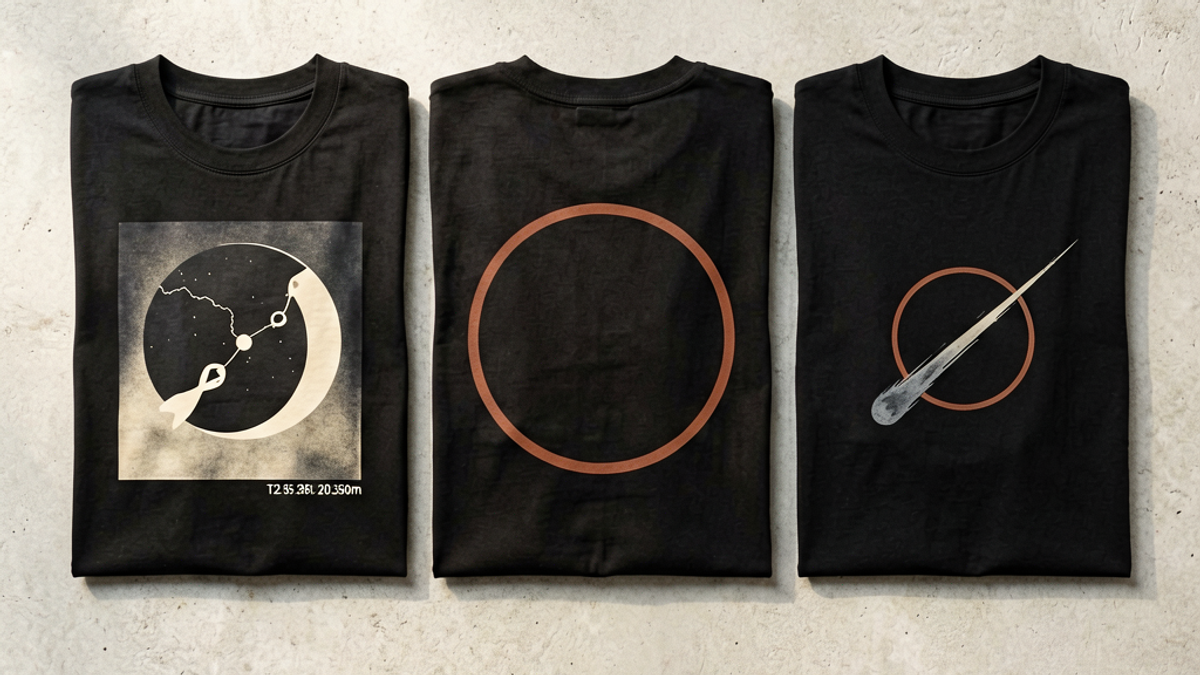
The path-of-totality chest mark. A four-inch left-chest print of the totality ribbon clipped to the buyer's region, with '08·12·2026' and a single coordinate pair set in a clean monospace underneath. This 2024 form factor held its resale value longest because it localised the event without resorting to face prints. Labels should ship one print per region — the split is what kept the 2024 state-park tees on shelves into 2025.
The corona-only back print. A twelve-inch full-back corona ring printed in a single matte ink on a heavyweight black or oxblood tee. No face, no readable type, no coordinate. The back-print placement lets the buyer stay quiet from the front and graphic from the back. A 2024 corona back-print is still wearable in 2026 because the iconography is event-agnostic.
The Perseid crossover graphic. A small chest print that combines a thin corona ring with a single meteor streak crossing it diagonally, set in a restrained two-color palette. This is the August 12–specific design that closes the Perseid crossover window. It reads as celestial at twenty feet and as fashion at three, and stops selling the moment the Perseid tail passes on August 13.
Why the Perseid crossover changes the math
The Perseid meteor shower peaks on the night of August 12–13, 2026, with the highest hourly rates typically between midnight and dawn. The eclipse peaks earlier the same day, which means the capsule is competing for two cultural moments inside one 24-hour window, and the Perseid tail extends the selling window by roughly 36 to 48 hours.
For streetwear buyers, the Perseid crossover is the part of the capsule that does not require being inside the path of totality. A deep-partial viewer in Cleveland can wear a Perseid-crossover tee as a non-literal reference to the eclipse night, and a non-viewer in Los Angeles can wear the same tee as a meteor-shower reference with no eclipse context at all. That dual-anchor is what makes the crossover graphic the highest-margin piece in the capsule, and it stops selling the moment the Perseid tail passes on August 13.
Where eclipse capsules usually go wrong
The first failure mode is treating the eclipse as a generic celestial event. Programs that drop a generic 'sun and moon' graphic — large crescent over a circle, sans-serif type, no date, no path — perform badly against path-map and corona prints because the generic print competes on the same shelf without offering the local specificity that drove 2024 sell-through. Every eclipse graphic in the capsule should answer one of two questions: where was the viewer, or what does the corona look like.
The second failure is over-printing the date. A 2024-era eclipse tee with '04·08·2024' set large across the chest aged immediately when August 12 was announced. The August 12 capsule should set the date small — a four-point mark on the sleeve hem, a one-line coordinate on the path-map tee — never as a hero front-print element. The date is the part that dates the garment fastest.
The third is pricing the program like collectible merch. Eclipse buyers will pay a premium for a 240-gsm tee with a clean corona print, but not a markup for the event alone. Programs that price a 180-gsm generic eclipse tee at the same point as a 240-gsm corona back-print see the corona print outsell the generic three to one. Keep the program and let buyers set the price-quality curve.
The Bottom Line
A total solar eclipse on August 12, 2026 crosses Greenland, Iceland and northern Spain, with a deep partial across 26 US states — and the event lands inside the Perseid peak, which doubles the capsule window. Independent labels have roughly 48 hours to ship a capsule built on three reusable tiers: a path-of-totality chest mark, a corona-only back print, and a Perseid crossover graphic. Skip generic celestial type, keep the date small, lean into the local path-map print, and let the corona print be the anchor that survives past August 13.
Frequently Asked Questions
When is the total solar eclipse in August 2026 and where can it be seen?
The total solar eclipse occurs on Wednesday, August 12, 2026. The path of totality crosses central Greenland, slices through Iceland between roughly 18:45 and 19:15 local time, and crosses northern Spain from Bilbao through Zaragoza to Valencia between roughly 20:25 and 21:00 local time. A deep partial eclipse — typically 40 to 90 percent obscuration depending on latitude — is visible across 26 US states from the mid-Atlantic through the Midwest, plus the UK, Ireland, France, Portugal and the Netherlands.
How does the August 12 2026 eclipse relate to the 2024 North American total?
The August 12 2026 total is the first total solar eclipse anywhere on Earth since the April 8, 2024 North American total, and the first to cross European landmass since the August 11, 1999 event. The 2024 total drove one of the largest single-event apparel spikes in modern streetwear history, and the reusable framework from that cycle — path-map chest prints, corona-only back prints, and glasses-shaped crop tees — is what the August 12 capsule should inherit. The 2024 cycle is the playbook for both indie labels and large-capsule programs.
What graphic tees hold up best for an August 12 2026 eclipse capsule?
Three tiers hold up across viewers and non-viewers: a path-of-totality chest mark with a regional ribbon and small date and coordinate underneath; a corona-only back print on a heavyweight tee in a single matte ink; and a Perseid-crossover graphic that combines a thin corona ring with a single meteor streak. None depends on the eclipse being seen, all three work in a streetwear rotation, and all three age better than generic sun-and-moon typography or large front-print dates.
Why does the Perseid meteor shower matter for an eclipse capsule?
The Perseid meteor shower peaks on the night of August 12–13, 2026, with the highest hourly rates typically falling between midnight and dawn. The eclipse peaks earlier the same day, which means the celestial-event capsule has two cultural moments inside one 24-hour window. The Perseid crossover graphic is the highest-margin piece in the capsule because it does not require being inside the path of totality — a deep-partial viewer or a non-viewer can wear the same tee as a celestial reference — and it stops selling the moment the Perseid tail passes on August 13.
Total Solar Eclipse Aug 12, 2026 — How the Path of Totality Becomes a | Stryxen Studio Blog
 Sylvie Vance