
## Why is the giant phantom jellyfish so rarely seen by humans?
The giant phantom jellyfish is a rarely observed deep-sea creature, distinguished by its unique oral arms and role as a significant deep-sea predator.
 Sylvie Vance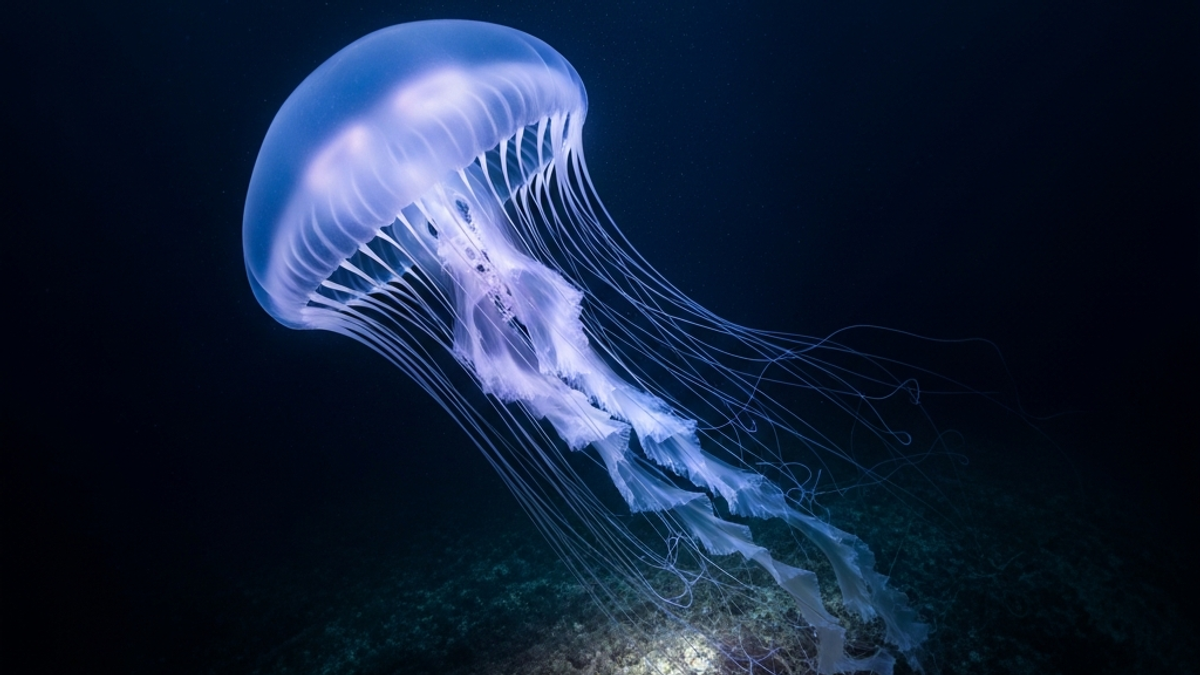
The rarity of sightings is directly attributable to the jellyfish's extreme habitat, which places it far beyond the reach of casual observation and often outside the range of standard deep-sea monitoring equipment (https://inaturalist.org/taxa/564145-Stygiomedusa-gigantea). The giant phantom jelly typically resides in the deep sea, often observed at depths between 80 and 280 meters, placing it in the twilight (mesopelagic) and lower epipelagic zones (https://en.wikipedia.org/wiki/Stygiomedusa). With only about 115 documented sightings over the last century, its existence is more often inferred through remote vehicle observations than direct encounters (https://inaturalist.ca/taxa/564145-Stygiomedusa-gigantea). This scarcity of data makes studying its behavior, population dynamics, and ecological role exceptionally difficult.
### What are the key physical characteristics that distinguish the giant phantom jellyfish?
The physical structure of *Stygiomedusa gigantea* sets it apart from most shallow-water jellyfish species. It possesses a large, umbrella-shaped bell that can reach up to a meter in length (https://megaquarium.fandom.com/wiki/Giant_Phantom_Jelly). Crucially, unlike many jellyfish that have numerous stinging tentacles, the phantom jelly is defined by four massive, paddle-like or kite-like oral arms, which can extend to lengths of up to 10 meters (https://megaquarium.fandom.com/wiki/Giant_Phantom_Jelly). These long appendages are used to capture prey, which generally consists of plankton and small fish (https://en.wikipedia.org/wiki/Stygiomedusa). Its coloration is also distinctive, often described as being deep red or purplish, which provides excellent camouflage in the dimly lit deep-sea environment where red light does not penetrate well.
### What is the scientific classification and evolutionary significance of *Stygiomedusa*?
The giant phantom jellyfish holds a unique taxonomic position. It is the only known species within the genus *Stygiomedusa*, classifying it as the sole member of that group (https://critter.science/the-mysterious-phantom-jellyfish/). This singularity suggests it represents an ancient or highly specialized lineage within the Cnidaria phylum. While it is sometimes placed within the family Ulmaridae, its distinct morphology—especially the ribbon-like oral arms instead of numerous tentacles—has led scientists to study its evolutionary divergence closely (https://inaturalist.org/taxa/564145-Stygiomedusa-gigantea). Its classification underscores the vast, unexplored biodiversity remaining in the world's oceans, as an organism this large has remained relatively isolated in the scientific record.
### How does the giant phantom jellyfish impact the deep-sea ecosystem?
As one of the largest invertebrate predators documented in the deep sea, the giant phantom jellyfish plays a significant, albeit understudied, role in the marine food web (https://en.wikipedia.org/wiki/Stygiomedusa). Its diet primarily includes plankton and small fish, meaning it acts as a major consumer in the bathypelagic and mesopelagic zones (https://en.wikipedia.org/wiki/Stygiomedusa). By preying on smaller organisms, it helps regulate the biomass of these middle layers of the ocean. Furthermore, its massive size means that when it eventually dies, its carcass contributes a substantial "food fall" to benthic communities below, providing vital nutrients to deep-sea scavengers. Its very existence highlights the complex trophic relationships that persist in environments characterized by scarcity and darkness.
***
### Key Takeaways and Future Outlook
The recent focus on the giant phantom jellyfish underscores a broader scientific trend: utilizing advanced deep-sea technology to survey previously inaccessible environments.
* **Extreme Rarity:** The *Stygiomedusa gigantea* is exceptionally rare, with fewer than 120 confirmed sightings in over a century, primarily due to its deep-sea habitat.
* **Unique Morphology:** It is distinguished by its bell shape (up to 1 meter) and four massive, ribbon-like oral arms that can stretch up to 10 meters long.
* **Ecological Role:** It functions as a major invertebrate predator, feeding on plankton and small fish in the mesopelagic zone.
* **Taxonomic Significance:** It is the sole species in the genus *Stygiomedusa*, highlighting a unique evolutionary branch in deep-sea life.
The future of phantom jellyfish research depends entirely on technological advancements in remotely operated vehicles (ROVs) and deep-sea imaging. As exploration capabilities expand, scientists hope to document more individuals, gather genetic samples, and finally understand the reproductive cycle and full geographic distribution of this deep-sea giant, potentially revealing more about the evolution of life in extreme conditions.
***
## Conclusion
The giant phantom jellyfish is far more than a fleeting curiosity captured on a submersible camera; it is a biological testament to the mysteries held within the deep ocean. Its sheer size, unique anatomy, and profound rarity force us to reconsider the scale and complexity of life thriving beyond the sunlit surface. As news of its sightings continues to surface, it serves as a powerful reminder that despite centuries of maritime exploration, the majority of our planet's biosphere remains a frontier awaiting scientific discovery. Understanding creatures like *Stygiomedusa gigantea* is essential to fully mapping the health and biodiversity of our global marine environment.
## References
* https://critter.science/the-mysterious-phantom-jellyfish/
* https://megaquarium.fandom.com/wiki/Giant_Phantom_Jelly
* https://en.wikipedia.org/wiki/Stygiomedusa
* https://www.inaturalist.org/taxa/564145-Stygiomedusa-gigantea
* https://inaturalist.ca/taxa/564145-Stygiomedusa-gigantea