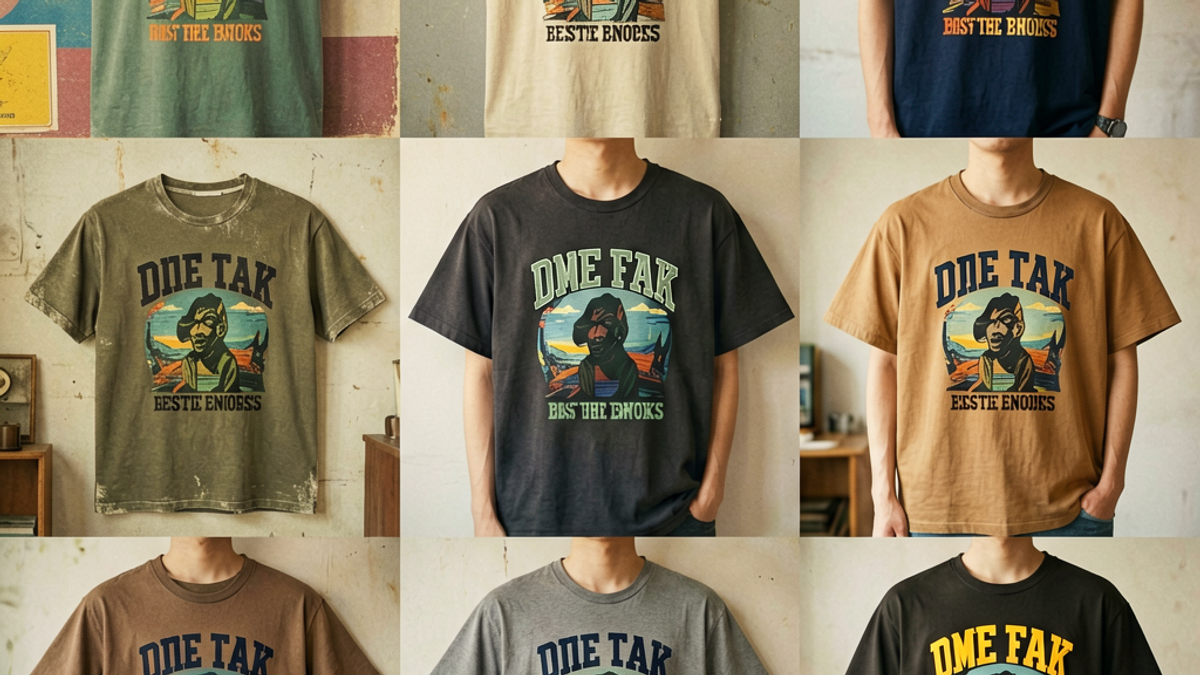
Graphic tees keep trending because they're the cheapest canvas for personal style with the longest shelf life. A $35 shirt says more about you than a $300 jacket, and you can rotate it through...
Sylvie Vance
•
Graphic tees keep trending because they're the cheapest canvas for personal style with the longest shelf life. A $35 shirt says more about you than a $300 jacket, and you can rotate it through three wardrobes a year without it aging out. Every generation re-discovers the same trick: one loud cotton rectangle, infinite identity payload, no commitment required.
Why Graphic Tees Are Still Trending: The Cheap-Canvas Thesis
Most trend pieces die because they cost too much to be casual and too little to be considered. The graphic tee sits in the rare middle: cheap enough that wearing it to the grocery store doesn't feel like a waste, expressive enough that the same tee still does the talking at the bar afterwards. That's the whole engine.
A bare t-shirt is a blank rectangle. Add a graphic and you get a wearable opinion for the price of two coffees. The math has not changed since the 1960s, and it is still unbeatable. Stüssy figured this out in 1980 with hand-scrawled logos, Hard Rock Cafe figured it out with tourist-thread tourist merch in 1971, and every streetwear label since has been refining the same formula: print something loud, sell the cotton cheap, let the buyer do the marketing.
Compare that to the alternatives. A statement jacket announces one specific thing every time you wear it — get the message wrong in 2024 and the same jacket ages you in 2026. A pair of designer sneakers photographs well but reads expensive, which excludes the people whose taste you'd actually want to borrow. The graphic tee is the only piece of clothing that scales from $15 fast-fashion to $300 collectible without anyone questioning the choice.
Why Trends Keep Cycling Back to Graphics Every Decade
Fashion trends cycle on a 20-year lag, give or take. The 70s revival of the late 90s. The 90s revival of the late 2010s. The 2000s revival that peaked around 2023 and is now cooling. Every cycle pulls the graphic tee back into the spotlight because the tee is the carrier wave for whatever era is being revived.
1970s revival (mid-90s): Concert tees from arena-rock tours — Van Halen, Led Zeppelin, The Rolling Stones — got a second life when grunge and alternative rock made the worn band shirt the uniform of every teenager who'd rather thrift than buy new.
1990s revival (late 2010s): Skater brands and hip-hop labels dominated. Tommy Hilfiger, FUBU, ECKO, and the entire Looney Tunes / Warner Bros bootleg universe drove the cycle. Vintage 90s tees hit $100+ on Grailed by 2020.
2000s revival (early 2020s): Ed Hardy, Von Dutch, rhinestone graphics, trucker hats. Looks ridiculous now in isolation, but the design language bled into every Y2K-coded drop from Palace and Stüssy through 2024.
2010s revival (mid-2020s): Tumblr-era graphics, indie band merch, the entire Vine-to-Y2K nostalgia pipeline. This is where we are now, and graphic tees are still the most efficient way to wear the era.
The cycle works because each generation thinks they discovered the graphic tee. They didn't. The tee was sitting there the whole time, waiting for the next batch of 16-year-olds to realize that printed cotton is the most expressive thing a teenager can afford.
The 2026 Forces Driving the Graphic Tee Trend
Three structural forces are pushing the trend harder right now than at any point since the 90s. None of them are fashion — they're economic and technological — and that's why the trend feels durable rather than fleeting.
AI-generated graphics have broken the cost barrier on the supply side. A small label used to pay $500 to $2,000 for a screen-ready illustration. Now an independent designer can generate fifty print-ready graphics in an afternoon for the cost of a subscription. The flood of new designs means there's a graphic tee for every micro-tribe, and the micro-tribes have the disposable income to support them. This is the first time the supply side has been this democratic.
Nostalgia is no longer a wave — it's the ocean. Gen Z's relationship with the 1990s is now longer than their relationship with their own childhood. They're nostalgic for an era they never lived through, and the graphic tee is the cheapest way to perform that nostalgia. The same mechanism drove millennial vintage hunting in the 2010s, except now there's a generation behind them with even deeper pockets and shorter attention spans.
Drop culture turned the tee into a collectible. Supreme, Palace, Brain Dead, and a hundred smaller labels release tees as limited drops that sell out in minutes. The resale market treats a rare graphic tee the way it treats a sneaker — grailed, stockx, depop. When a $45 shirt resells for $250, the entire category shifts up the cultural ladder. The tees you don't wear become the tees you invest in. That's new, and it locks the trend in for at least another cycle.
Generational Shifts in How Graphic Tees Get Worn
The tee itself hasn't changed much in fifty years. Cotton, screen print, crew neck, short sleeves. What changed is how each generation wears it. The styling tells you more about the era than the graphic does.
Gen Z (born ~1997–2012): Oversized, often layered over long sleeves, paired with low-rise or baggy pants. The graphic is part of a costume, not a focal point. Thrifting is the dominant sourcing channel — Depop, eBay, local thrift stores. Worn-in is the goal, not pristine.
Millennials (born ~1981–1996): Slim or regular fit, often tucked or half-tucked. The graphic is the focal point. Sourced from a mix of indie labels, band merch, and curated vintage. Will pay $80–$200 for a known vintage piece without blinking.
Gen X (born ~1965–1980): The original graphic tee generation. Wears them ironic, ironic-but-not, and sincere depending on the day. Most likely to own a vintage tee that's actually from the era it depicts. Style has stopped trying to impress anyone.
The shift across these three groups is what's keeping the category fresh. Each generation styles the tee differently, which means the same shirt reads completely different depending on who's wearing it. That contextual flexibility is what kills trends — and what's keeping this one alive.
Where the Graphic Tee Trend Is Heading Next
Three signals point to where the trend goes from here, and none of them involve graphic tees going away. The category is too useful, too cheap, and too expressive to die on any timeline shorter than a generation.
Personalization goes mainstream. Print-on-demand services have collapsed the minimum order quantity from 50 shirts to 1 shirt. The next wave is one-off graphics: AI-assisted, personal-archive-sourced, or hand-drawn by the wearer. By 2027, a meaningful slice of graphic tee sales will be unique-to-the-buyer rather than mass-produced. The collectible drop model extends to every tee, not just the rare ones.
Sustainability pressure forces a quality correction. Fast-fashion graphic tees are increasingly obvious — thin cotton, plastic-feeling prints, single-wash cracking. The 2026 consumer can tell. Premium basics labels are responding with heavier cotton, water-based inks, and rebuilt supply chains. The price floor for a decent graphic tee has moved from $12 to $30 over the last five years and will likely settle at $35–$45 as the entry tier.
The graphic tee becomes the default canvas for cross-category collabs. Already happening: album drops, sneaker launches, beer brands, anime series, restaurant merch, university bookstores, even fitness brands. The tee is the lowest-friction merch surface in the entire fashion industry. Any brand that wants to extend into apparel without building a full line starts with the tee.
Key Takeaways
Graphic tees are the cheapest canvas for personal style with the longest shelf life — no other garment does the same job at the same price.
Trends cycle back every 20 years because the tee is the carrier wave for whatever era is being revived — 70s, 90s, 2000s, 2010s, all of them.
Three forces are driving 2026: AI art flooded supply, nostalgia became permanent, and drop culture turned tees into collectibles.
Generations style the tee differently — Gen Z layers oversized, millennials tuck slim, Gen X wears them anyway — which keeps the category from feeling tired.
Next: personalization at scale, a $35+ quality floor, and the tee as the default merch surface for every cross-category collab.
The Shirt That Outlasts Every Trend It Carries
The graphic tee is the only piece of clothing that has been continuously trending since the 1960s. Not because it changed — it barely has — but because the job it does is permanent. Loud cotton. Cheap canvas. Infinite payload. The trend doesn't drive the tee. The tee drives every trend it gets attached to.
If you're building a rotation that leans into this — graphic tees that read current without trying too hard, that work across venues and eras — the Stryxen Studio collection is built around exactly that idea. Pick the graphic that says something you mean, wear it until the cotton softens, and let the rest of the outfit stay out of its way. That's the whole formula.
Frequently Asked Questions
Why are graphic tees still so popular?
Because they remain the cheapest way to express identity through clothing. A $30–$45 graphic tee says more about the wearer than a $300 jacket, can be rotated through three wardrobes a year without aging out, and survives every fashion cycle because it carries the era that's being revived. Drop culture, AI-generated art, and cross-category collabs have all extended the trend's life since 2020.
Are graphic tees out of style in 2026?
No — graphic tees are still firmly in style in 2026. The category has actually grown more relevant because of limited-edition drops, AI-assisted design, and the continued nostalgia cycle. What's shifted is the styling: oversized fits with low-rise or baggy pants are dominant, layered over long sleeves is common, and pristine fast-fashion tees are increasingly rejected in favor of thrifted or premium-cotton alternatives.
What kind of graphic tees are trending right now?
Vintage and vintage-inspired graphics dominate — faded single-stitch 90s tees, 2000s Y2K rhinestone graphics, band merch from defunct tours, and AI-assisted one-off designs from independent labels. Micro-tribal graphics (specific anime, niche music scenes, regional references) are also strong. Plain logo tees and minimal wordmark designs remain evergreen but aren't the part of the category doing the growing.
How many graphic tees should you own?
For most wardrobes, 6–10 graphic tees is the sweet spot — enough to rotate through a week without repeating, few enough that each one actually gets worn. Quality matters more than quantity: two heavyweight $45 tees outlast and outperform eight $12 fast-fashion ones. If you're collecting for resale or drops, the math is different, but for everyday wear, lean toward fewer, better pieces.
Why Are Graphic Tees Still Trending in 2026? | Stryxen Studio Blog

 Sylvie Vance