## What exactly is the giant phantom jellyfish (*Stygiomedusa gigantea*)?
The rare, massive *Stygiomedusa gigantea* inhabits the deep sea; sightings via ROVs advance understanding of this dark, extreme ecosystem.
 Sylvie Vance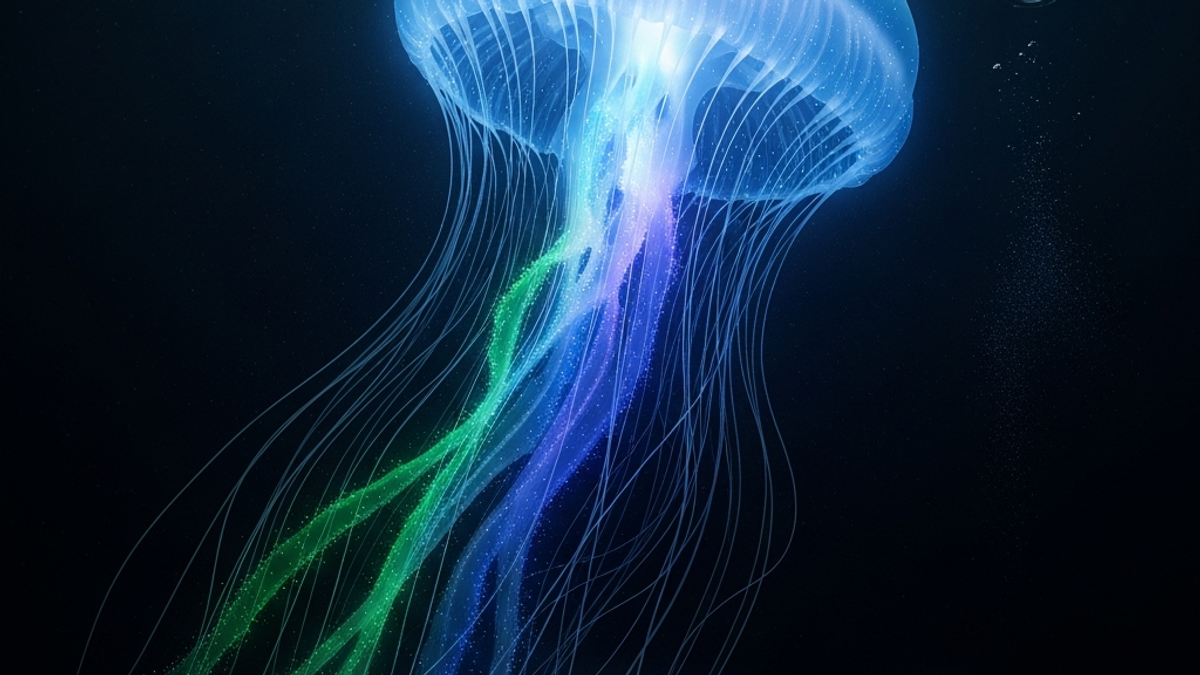
The giant phantom jellyfish is one of the largest known jellyfish species, capable of growing to lengths comparable to a school bus (https://www.burlingtonfreepress.com/story/life/animalkind/2026/02/04/rare-bus-sized-giant-phantom-jellyfish-caught-on-camera-see-video/88509145007/). Scientifically named *Stygiomedusa gigantea*, its name reflects its immense size and ghostly appearance. Unlike many shallow-water jellyfish, this species is characterized by a large, deep-red bell that can reach about a meter in diameter and four long, thick oral arms that can trail for many meters (https://www.instagram.com/reel/DUWTGBvE3Mf/). These oral arms are not stinging tentacles but are used to capture prey, which primarily consists of small crustaceans and other deep-sea organisms (https://www.youtube.com/shorts/8CBKSBOAQis).
### Where and how are these jellyfish typically sighted?
Giant phantom jellyfish sightings are extremely rare because they inhabit the bathypelagic zone, commonly known as the "midnight zone," which ranges from approximately 1,000 to 4,000 meters (3,300 to 13,000 feet) below the surface (https://www.nbcmiami.com/news/national-international/rare-phantom-jellyfish-argentina-deep-sea-exploration/3759074/). Recent sightings, including the one off Argentina's coast, occurred during deep-sea exploration missions utilizing remotely operated vehicles (ROVs) deployed from research vessels (https://www.youtube.com/shorts/8CBKSBOAQis). The ROVs allow scientists to observe the jellyfish in its natural, undisturbed environment without the artificial light and pressure changes associated with bringing specimens to the surface, which often damages them. The Schmidt Ocean Institute footage, for instance, captured the organism moving slowly through the deep Pacific (https://www.instagram.com/reel/DUWTGBvE3Mf/).
### Why are these sightings considered significant for deep-sea research?
Every confirmed sighting of *Stygiomedusa gigantea* is significant because it offers vital clues about the ecology and biodiversity of the deep ocean, one of the least understood ecosystems on Earth (https://www.instagram.com/reel/DUWTGBvE3Mf/). Because the jellyfish is so seldom encountered, direct observation helps researchers understand its movement, feeding strategies, and overall role in the abyssal food web (https://www.facebook.com/DesMoinesRegister/posts/a-stygiomedusa-gigantea-commonly-known-as-the-giant-phantom-jelly-was-filmed-at-/1324812996350538/). The rarity of the sightings implies that the species has a very low population density or highly specialized distribution patterns. By filming these creatures, scientists gather baseline data that is impossible to collect through net trawling, thus improving our understanding of life in extreme marine environments (https://www.youtube.com/shorts/8CBKSBOAQis).
### What does the recent discovery tell us about the jellyfish's habitat or behavior?
The recent expedition that spotted the jellyfish off Argentina specifically contributed to mapping the distribution of these rare organisms in the South Atlantic (https://www.nbcmiami.com/news/national-international/rare-phantom-jellyfish-argentina-deep-sea-exploration/3759074/). Observations often reveal that the jellyfish are relatively slow-moving, utilizing their massive oral arms to passively trail and sweep through the water column to intercept drifting prey (https://www.instagram.com/reel/DUWTGBvE3Mf/). Furthermore, these sightings, often at depths exceeding 800 meters (about 2,600 feet), reinforce that the species is highly adapted to the high-pressure, low-temperature, and complete darkness of the deep sea (https://www.burlingtonfreepress.com/story/life/animalkind/2026/02/04/rare-bus-sized-giant-phantom-jellyfish-caught-on-camera-see-video/88509145007/).
### Key Takeaways: Understanding Deep-Sea Giants
The recent observation of the giant phantom jellyfish underscores several key points regarding deep-sea biology:
* **Rarity Confirmed:** The species remains one of the most seldom-seen large animals, validating its status as a creature of the deep abyss.
* **Technological Reliance:** Current knowledge about *S. gigantea* is almost entirely dependent on advanced ROV technology and deep-sea research expeditions (https://www.youtube.com/shorts/8CBKSBOAQis).
* **Geographic Range Expanding:** Repeated modern sightings, such as those by the Schmidt Ocean Institute, help create a clearer map of their global distribution across the world's oceans.
* **Unique Adaptation:** The creature’s structure—massive size, deep-red coloration (often appearing black in the deep sea), and specialized feeding arms—represents a successful evolutionary path for surviving in perpetual darkness.
The future outlook for understanding this species hinges on continued, non-invasive deep-sea exploration. As ROV technology becomes more accessible and sophisticated, scientists anticipate more frequent encounters, leading to a richer understanding of deep-sea trophic levels and overall oceanic health.
***
The sighting of the giant phantom jellyfish serves as a powerful, tangible reminder of the vast, unexplored wilderness that still exists beneath the waves. These fleeting glimpses into the abyssal realm challenge our preconceptions about life's limits and emphasize the critical need for conservation efforts, even in areas we cannot easily see. Each encounter with a creature like *Stygiomedusa gigantea* is not just a scientific victory; it is an invitation to contemplate the mysteries hidden within our own planet.
## References
* https://www.instagram.com/reel/DUWTGBvE3Mf/
* https://www.youtube.com/shorts/8CBKSBOAQis
* https://www.nbcmiami.com/news/national-international/rare-phantom-jellyfish-argentina-deep-sea-exploration/3759074/
* https://www.facebook.com/DesMoinesRegister/posts/a-stygiomedusa-gigantea-commonly-known-as-the-giant-phantom-jelly-was-filmed-at-/1324812996350538/
* https://www.burlingtonfreepress.com/story/life/animalkind/2026/02/04/rare-bus-sized-giant-phantom-jellyfish-caught-on-camera-see-video/88509145007/