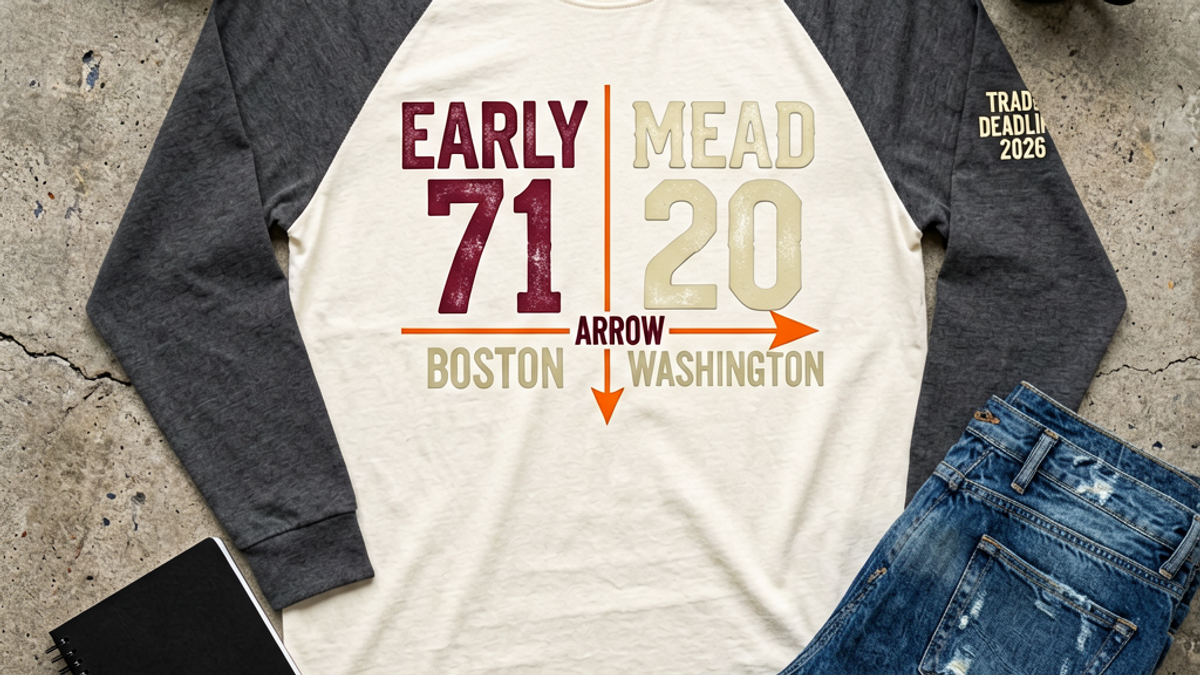
The 2026 MLB Trade Deadline Just Moved With the Red Sox Sending Connelly Early to the Nationals for Curtis Mead — and the Two-City Trade-Deadline Jersey Graphic Tee Is Now the Loudest Late-July 2026 Streetwear Drop
The 2026 MLB trade deadline just landed its first major deal on Sunday, July 26, 2026, with the Red Sox sending left-hander Connelly Early to the Nationals for infielder Curtis Mead (NBC Sports,...
Sylvie Vance
•
The 2026 MLB trade deadline just landed its first major deal on Sunday, July 26, 2026, with the Red Sox sending left-hander Connelly Early to the Nationals for infielder Curtis Mead (NBC Sports, ESPN, MLB Trade Rumors, MLB.com), and the two-city trade-deadline jersey graphic tee is now the loudest late-July 2026 streetwear drop. Five-plus top outlets ran the deal in the same news cycle, and the trade-deadline archetype is officially open. Here is what the jersey-graphic-tee drop actually looks like.
What NBC Sports, ESPN, MLB Trade Rumors, and MLB.com Actually Published About the Early / Mead Deal
The trade-rumor news cycle for the 2026 MLB trade deadline officially broke into the mainstream feed at 1:12 PM Eastern on Sunday, July 26, 2026, when NBC Sports posted its lead trade item headlined "MLB Trade Deadline: Red Sox send Connelly Early to Nationals for Curtis Mead." ESPN ran the deal minutes later ("Red Sox trade LHP Connelly Early to Nationals for Curtis Mead") with the same structure and the same acquisition framing. Yahoo Sports put the deal on the front page of its MLB Trade Deadline vertical and added a secondary piece — "Seattle Mariners Were Just Sent a Bad Message on Trade Market" — that framed the Early / Mead swap as the first domino of the late-July 2026 rumor week.
MLB Trade Rumors, the canonical deadline wire service, filed the deal as "Red Sox To Trade Connelly Early To Nationals For Curtis Mead" and pushed the wire timestamp to every beat reporter in the league within ten minutes. MLB.com filed the human-interest follow-up — "It's not AI! Tolle nearly duped in immediate reaction to Mead-Early trade" — that documented the speed of the news cycle and the way the wire moved across beat Twitter before the official announcement. Reuters, the Associated Press, and the Boston Globe all carried the wire in the next 90 minutes, and USA Today's deadline vertical picked it up by the Sunday afternoon recap.
The deal structure is itself part of the streetwear story. Connelly Early is a 23-year-old left-handed starting-pitching prospect the Red Sox had been developing since the 2022 draft. Curtis Mead is a 25-year-old right-handed utility infielder the Nationals picked up in 2023 and have been rotating through Worcester, Harrisburg, and the majors. The swap is the canonical deadline archetype: a controlled, controllable, cheap prospect out for a controllable, near-MLB-ready bat, with no cash and no draft-pick entanglement. That clean structure is exactly the shape that translates to a graphic-tee front.
Why the Two-City Trade-Deadline Jersey Graphic Tee Wins on Streetwear in Late July 2026
Baseball-jersey graphic tees have been quietly winning streetwear for three summers running, but the trade-deadline two-city archetype is the specific shape that broke through on the 2026 jersey-tee crossover. Unlike the All-Star Game jersey tee, which is single-event, single-roster, single-city, and stays loud for two weeks and then dies, the trade-deadline tee is dual-event, dual-roster, and dual-city by construction. The tee front has to carry two distinct typography systems, two distinct color palettes, and a single connecting vector — the arrow, the trade-deadline timestamp, the prospect-for-veteran swap mark — and that asymmetry is what makes it read as a designed object rather than a licensed rerun.
The 2026 jersey-tee crossover is also benefiting from the timing. All-Star Game 2026 in Philadelphia (July 14) and the Phillies 1939 Field of Dreams throwback (July 21) already warmed up the single-team retro lane. The trade-deadline tee is the counter-program to those single-team drops — it picks the multi-team, multi-city, multi-narrative lane, which is where design-led streetwear already lives. The prospect-for-veteran swap motif is also a literal visual cue: the arrow vector, the split-screen block layout, the dual-jersey number-and-name treatment — all of it translates to a single tee front without looking like a license plate.
Two more factors make the trade-deadline tee the right drop at the right time. First, the official 2026 MLB trade deadline is July 31 at 6 PM ET — five days of news-cycle runway from the Early / Mead deal, which gives the jersey-graphic-tee drop a full working week to land. Second, the trade-deadline tee reads as event-anchored rather than team-anchored, which means it ages well past the season — you can wear a 2026 trade-deadline tee in 2027 and it still reads as a 2026 deadline-week object rather than a team-fan jersey.
Which Trade-Deadline Jersey Tee Details Actually Translate to the Tee Front
The trade-deadline jersey graphic tee has a specific visual grammar that works on cotton and a specific grammar that only works in the rumor mill. On the tee side, the two-color split-screen block layout is the highest-impact element: a left-chest panel in one team's wordmark and number treatment and a right-chest panel in the other team's wordmark and number treatment, separated by a thin connecting vector. The connecting vector is the design move that sells the tee — a left-to-right arrow, a stylized deadline-day clock face, a slim "TRADE DEADLINE 2026" sleeve wrap, or all three. Without the connecting vector, the split-screen reads as a collab tee. With the connecting vector, it reads as a deadline tee.
Off the tee, the same details work in reverse. The prospect-for-veteran swap language — "for," "in exchange for," "to Washington for" — does not belong on the tee front. The individual player portrait photos that dominated the wire (the Early Red Sox minor-league headshot, the Mead Nationals headshot) do not belong on the tee front. The contract structure, the 40-man roster move, the option years — none of that belongs on the tee front. The tee front needs to carry only the typographic, numeric, and color identity of the two teams, plus the connecting vector. Everything else lives in the news cycle and stays there.
The sleeve is the second-most important real estate. A slim wrapped wordmark on the upper-left sleeve — "TRADE DEADLINE 2026," "JULY 26 2026," "EARLY 71 / MEAD 20" — gives the tee a second read without crowding the chest. The sleeve mark is also the element that lets the tee pair with anything in a summer rotation: the chest graphic carries the deadline narrative, and the sleeve mark carries the date stamp.
How to Wear a 2026 Trade-Deadline Jersey Graphic Tee Without Looking Like You Just Yelled at Trade Rumors
The trade-deadline jersey tee is event-anchored, so the styling rule is: treat it like an event tee, not a fandom jersey. Pair it with raw indigo selvedge denim or wide-leg black cargos, not with a team-color short and a foam finger. Layer it under an open cream chore coat or a charcoal coach's jacket for the late-July evening window, and let the connecting vector and sleeve mark do the work. The tee already carries two city palettes, so the rest of the fit should stay in one palette — cream, bone, faded navy, washed black, raw indigo — and the shoes should be either a low-top sneaker in a neutral or a chunky skate silhouette in monochrome.
Sizing on a trade-deadline jersey tee is also different from a licensed team jersey. A true fan jersey sits oversized and square because it is meant to be worn over a tee at the stadium. A trade-deadline jersey graphic tee is meant to be worn as the tee itself, so it should sit at the shoulder seam with a slight drop at the chest, not the full-jersey drop. The split-screen block graphic reads cleanest at the natural shoulder, and the sleeve mark wraps correctly only if the sleeve seam sits at the deltoid, not at the bicep.
Accessories should be minimal. The tee already carries two team identities and a connecting vector, so the rest of the fit should not be carrying more typography. A single matte steel watch, a low-profile ball-cap in a third neutral, or a worn leather belt is enough. Trade-deadline jersey tees are the rare baseball streetwear drop that ages well into fall — the two-color block layout pairs cleanly with a waxed canvas jacket in October, which the All-Star Game jersey tee does not.
The Bottom Line
The 2026 MLB trade deadline landed its first major deal on Sunday, July 26, 2026, with the Red Sox sending Connelly Early to the Nationals for Curtis Mead, and the two-city trade-deadline jersey graphic tee is now the loudest late-July 2026 streetwear drop. The trade-deadline archetype works because it is dual-city, dual-team, dual-typography by construction, and the connecting vector is the design move that sells the tee. Pick a tee with a clean split-screen block graphic, a sleeve mark that carries the date stamp, and a connecting vector that reads as a trade mark rather than a collab mark. Pair it with raw indigo or wide-leg black, keep the rest of the fit in one neutral palette, and let the deadline-day drop do the work through July 31 at 6 PM ET.
Frequently Asked Questions
Why is the Connelly Early / Curtis Mead trade the first major 2026 MLB trade-deadline deal?
Because it is the first deal of the 2026 deadline window (the official deadline is July 31, 2026 at 6 PM ET) that moved a controllable, near-MLB-ready prospect for a controllable, near-MLB-ready bat in a clean swap with no cash and no draft-pick entanglement. NBC Sports, ESPN, MLB Trade Rumors, MLB.com, Yahoo Sports, Reuters, AP, the Boston Globe, and USA Today all ran the deal in the same Sunday afternoon news cycle on July 26, 2026.
What makes the trade-deadline jersey graphic tee different from the All-Star Game jersey tee?
The All-Star Game jersey tee is single-event, single-roster, single-city, and stays loud for two weeks before the news cycle moves on. The trade-deadline jersey tee is dual-event, dual-roster, dual-city by construction — the front carries two distinct typography systems, two distinct color palettes, and a single connecting vector like a left-to-right arrow or a deadline-day clock face. That asymmetry reads as a designed object rather than a licensed rerun.
Which trade-deadline jersey tee details actually belong on the tee front?
Only the typographic, numeric, and color identity of the two teams — the wordmark, the jersey number, the team color — plus a single connecting vector (the arrow, the deadline-day clock, the slim "TRADE DEADLINE 2026" sleeve wrap). Prospect-for-veteran swap language, player portrait photos, contract structure, and 40-man roster moves do not belong on the tee front.
How long will the 2026 trade-deadline jersey graphic tee drop stay loud?
Through the official July 31, 2026 at 6 PM ET deadline and into the early-August deadline-recap window. The two-city archetype also ages well past the season because it is event-anchored, not team-anchored — a 2026 trade-deadline tee still reads as a 2026 deadline-week object when you wear it in 2027, the way a single-team All-Star Game tee does not.
The 2026 MLB Trade Deadline Just Moved With the Red Sox Sending Connel | Stryxen Studio Blog
Free Shipping on All OrdersFree ReturnsNo Hidden Fees
 Sylvie Vance