
How are local authorities, such as the NYPD, responding to the "no kings protest"?
The NYPD effectively managed the large-scale 'no kings protest' by employing de-escalation strategies and implementing significant street closures, which led to an almost non-existent number of arrests.
 Sylvie Vance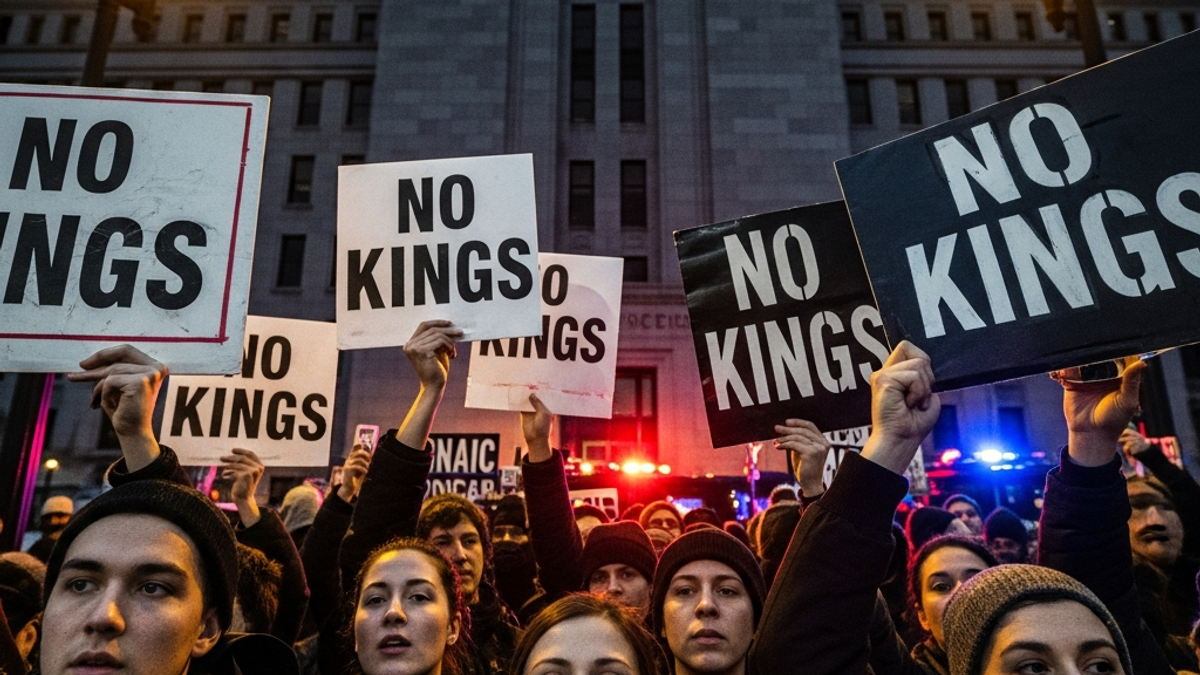
Local authorities, specifically the New York City Police Department (NYPD), responded to the "no kings protest" demonstrations by deploying officers trained in de-escalation tactics to monitor the events across the five boroughs, while also making strategic street closures to manage the massive crowds (Source: [youtube.com/watch?v=TkGO37NCr0M](https://www.youtube.com/watch?v=TkGO37NCr0M)). With estimates suggesting more than 100,000 participants flooded the streets, the NYPD focused on facilitating the peaceful exercise of First Amendment rights while maintaining public order, often resulting in minimal protest-related arrests (Source: [x.com/NYPDnews/status/1979630405289660472](https://x.com/NYPDnews/status/1979630405289660472), [abc7ny.com/post/more-hundred-thousand-protesters-flood-nyc-streets-no-kings-march/18034314/](https://abc7ny.com/post/more-hundred-thousand-protesters-flood-nyc-streets-no-kings-march/18034314/)). This measured approach, often preceded by warnings from the Mayor and Police Commissioner about zero tolerance for disorder (Source: [amny.com/police-fire/nypd-saturday-no-kings-day-protest/](https://www.amny.com/police-fire/nypd-saturday-no-kings-day-protest/)), highlights a strategic balance between civil liberties and city management.
### What specific crowd control and de-escalation tactics has the NYPD deployed for these protests?
The NYPD’s primary stated tactic for the "no kings protest" events involved proactive monitoring and the deployment of officers specifically trained in de-escalation techniques (Source: [youtube.com/watch?v=TkGO37NCr0M](https://www.youtube.com/watch?v=TkGO37NCr0M)). This suggests an emphasis on minimizing confrontation and allowing the assembly to proceed unless public safety is severely compromised. Furthermore, to manage the logistical impact of a demonstration involving over 100,000 people, the department implemented significant traffic control measures. This included shutting down major thoroughfares, such as Fifth Avenue between 42nd and 23rd Streets, as well as portions of 40th and 42nd Streets between Fifth and Sixth Avenues, to ensure pedestrian safety and manage the flow of the marchers (Source: [news.yahoo.com/nypd-shuts-down-streets-manhattan-182343137.html](https://news.yahoo.com/nypd-shuts-down-streets-manhattan-182343137.html)). This street management is a crucial, non-confrontational form of crowd control aimed at structural organization rather than direct engagement.
### How does the NYPD's response compare to previous large-scale demonstrations in NYC?
The response to the "no kings protest" appears to align with a post-2020 operational shift within the NYPD that emphasizes reduced aggressive intervention during large, generally peaceful assemblies. In many recent high-profile protests, city leadership, including the Mayor, has publicly signaled a commitment to facilitating First Amendment rights while warning against lawlessness (Source: [amny.com/police-fire/nypd-saturday-no-kings-day-protest/](https://www.amny.com/police-fire/nypd-saturday-no-kings-day-protest/)). The reported outcome of "zero protest-related arrests" (Source: [x.com/NYPDnews/status/1979630405289660472](https://x.com/NYPDnews/status/1979630405289660472)) suggests a high degree of success in managing the event according to de-escalation protocols, which contrasts with periods that saw more widespread use of tactical units or mass arrests for minor infractions during earlier waves of civil unrest. The scale of the mobilization, however, necessitates significant logistical preparation, as evidenced by the widespread street closures (Source: [news.yahoo.com/nypd-shuts-down-streets-manhattan-182343137.html](https://news.yahoo.com/nypd-shuts-down-streets-manhattan-182343137.html)).
### What legal or policy frameworks guide the NYPD's management of First Amendment assembly rights versus public order?
The management of large-scale protests in New York City is governed by a complex interplay of First Amendment jurisprudence, city permitting regulations, and internal NYPD policies regarding the use of force and assembly management. While the First Amendment guarantees the right to peaceful assembly, this right is not absolute; the government can impose reasonable "time, place, and manner" restrictions (Source: [aclu.org/other/speech-assembly-and-protest](https://www.aclu.org/other/speech-assembly-and-protest)). For large, unpermitted marches like some associated with "no kings" demonstrations, the NYPD operates under policies designed to ensure public safety, which includes controlling routes and street access (Source: [news.yahoo.com/nypd-shuts-down-streets-manhattan-182343137.html](https://news.yahoo.com/nypd-shuts-down-streets-manhattan-182343137.html)). The emphasis on de-escalation (Source: [youtube.com/watch?v=TkGO37NCr0M](https://www.youtube.com/watch?v=TkGO37NCr0M)) reflects an organizational commitment to minimizing actions that could be construed as suppressing protected speech, even while enforcing public order mandates. Authorities generally aim for a "hands-off" approach unless property damage or direct threats to life occur (Source: [amny.com/police-fire/nypd-saturday-no-kings-day-protest/](https://www.amny.com/police-fire/nypd-saturday-no-kings-day-protest/)).
### What was the overall outcome regarding arrests, public safety, and traffic disruption?
The overall outcome, based on initial reports from the authorities, leaned heavily toward a successful facilitation of the event with minimal negative externalities. The NYPD stated that the majority of the protests across all five boroughs dispersed with **zero** protest-related arrests (Source: [x.com/NYPDnews/status/1979630405289660472](https://x.com/NYPDnews/status/1979630405289660472)). This indicates a high degree of success in maintaining public safety without resorting to punitive measures against the demonstrators. While traffic disruption was significant due to street closures—a necessary byproduct of managing crowds exceeding 100,000 people (Source: [abc7ny.com/post/more-hundred-thousand-protesters-flood-nyc-streets-no-kings-march/18034314/](https://abc7ny.com/post/more-hundred-thousand-protesters-flood-nyc-streets-no-kings-march/18034314/))—the lack of major incident reports suggests the police managed the operational impact effectively.
### Key Takeaways for Understanding Civil Management in NYC
* **De-escalation Priority:** The NYPD deployed officers trained in de-escalation as a core strategy, indicating a shift toward minimizing direct conflict during large assemblies.
* **Logistical Dominance:** Major street closures are a predictable and necessary tool for managing crowds of this magnitude (100,000+ participants) to ensure pedestrian safety.
* **Low Arrest Rate:** The reported outcome of zero protest-related arrests highlights a successful execution of the strategy to protect First Amendment rights while maintaining order.
* **Clear Messaging:** City leadership pre-warned the public about preparing for the demonstrations while simultaneously setting expectations for behavior, demonstrating coordinated governance.
The future impact of these high-turnout, low-confrontation protests will be closely watched by other major cities. The NYPD’s demonstrated ability to manage massive crowds while achieving near-zero protest arrests sets a benchmark for law enforcement balancing civil liberties with necessary public order management in the modern era of frequent, large-scale civic expression.
***
The response of local authorities to the "no kings protest" movements in NYC provides a case study in modern metropolitan crowd management. It illustrates a sophisticated, multi-layered strategy that prioritizes logistical control and de-escalation over aggressive intervention. As political and cultural discourse continues to manifest in the streets, understanding the mechanisms used by the NYPD to uphold constitutional rights while protecting city functionality remains critical for both participants and the public at large.
## References
* https://www.youtube.com/watch?v=TkGO37NCr0M
* https://x.com/NYPDnews/status/1979630405289660472
* https://abc7ny.com/post/more-hundred-thousand-protesters-flood-nyc-streets-no-kings-march/18034314/
* https://news.yahoo.com/nypd-shuts-down-streets-manhattan-182343137.html
* https://amny.com/police-fire/nypd-saturday-no-kings-day-protest/
* https://www.aclu.org/other/speech-assembly-and-protest