Can you provide an update on the Starship development and its next test flight?
Starship's next test is projected for early March 2026, pending FAA approval and hardware readiness for Artemis missions.
 Sylvie Vance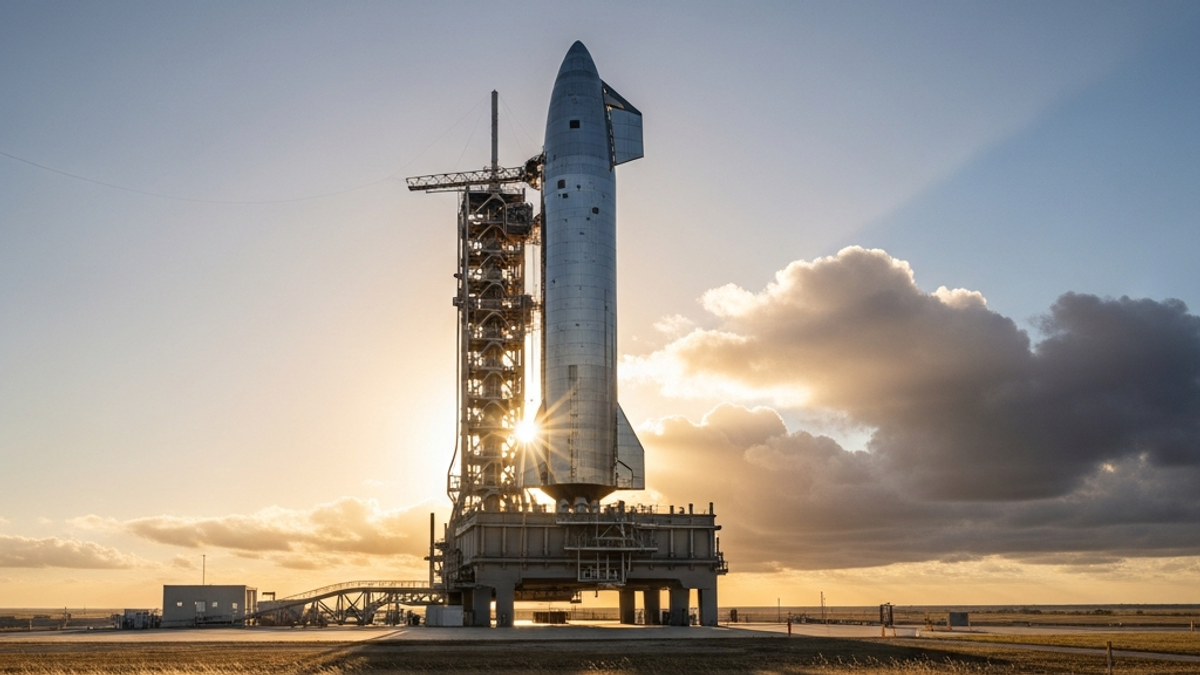
Starship's next integrated flight test (IFT), often referred to as Flight 12, is currently projected for an early March 2026 timeframe, contingent upon the completion of final hardware preparations and necessary regulatory approvals from the FAA **(https://www.youtube.com/watch?v=dmRkwLfHSK0)**. This upcoming mission is pivotal, as it represents the next major step in SpaceX’s iterative development process aimed at achieving full reusability and securing the vehicle for NASA's Artemis lunar missions, which adds significant pressure to the timeline.
***
### What are the primary technical and regulatory hurdles delaying the next Starship flight?
The schedule for the next Starship integrated flight test is highly dynamic, primarily influenced by two interlocking factors: engineering iteration following prior tests and the required federal oversight for launch licensing. Technically, SpaceX must complete extensive hardware verification, including final engine installation and static fire tests for both the Super Heavy booster and the Starship upper stage **(https://www.youtube.com/watch?v=dmRkwLfHSK0)**. Following previous test anomalies, such as the B18 incident, the company is dedicating significant time to rigorous pre-flight inspections and potential design refinements, understanding that a successful flight is crucial to maintain momentum **(https://www.youtube.com/watch?v=dmRkwLfHSK0)**. On the regulatory side, while SpaceX has a strong track record, each new flight requires renewed environmental reviews and Federal Aviation Administration (FAA) approval, a process that often introduces variability into the launch schedule **(https://www.spacelaunchschedule.com/news/spacex-starship-program-status/)**.
### How is the development of Starship progressing in relation to NASA's Artemis Moon mission requirements?
Starship's development is inextricably linked to NASA's Artemis program, where it is designated as the Human Landing System (HLS) for the Artemis III and subsequent missions. This connection means that Starship development must not only achieve orbital capability but also successfully qualify the specific systems required for lunar operations. A critical area of ongoing work involves the docking adapter qualification, where SpaceX is testing an androgynous docking system based on the flight-proven Dragon 2 architecture to link Starship with Orion in space **(https://www.spacex.com/updates)**. The reliability and maturity of Starship directly impact NASA’s overall timeline for returning astronauts to the Moon. Furthermore, SpaceX is concurrently working on qualification measures for other spacecraft components, including life support and abort procedures, through various simulations with NASA **(https://www.nasa.gov/feature/nasa-spacex-simulate-upcoming-crew-mission-with-astronauts/)**.
### What key design or operational changes were implemented following the last Integrated Flight Test (IFT)?
Each Integrated Flight Test serves as an essential, high-fidelity data collection event, driving immediate engineering changes. While specific component upgrades for Flight 12 are often proprietary until rollout, the primary operational lesson has centered on maximizing the success of the hot-staging process and ensuring the structural integrity of both stages during ascent **(https://www.youtube.com/watch?v=dmRkwLfHSK0)**. Post-test analysis leads to necessary improvements in shielding, structural reinforcements, and engine systems. Operationally, SpaceX has demonstrated an ability to rapidly turn around hardware, evidenced by the quick completion of Booster 19, although this rapid assembly is now being balanced with the need for more exhaustive component-level testing, such as heat shield testing on Ship 39 **(https://www.youtube.com/watch?v=dmRkwLfHSK0)**.
### What are the long-term implications of Starship’s success or failure on the broader space economy?
The successful development of Starship is forecast to be a major disruptive force across the entire space economy due to its promise of massive payload capacity and full, rapid reusability. If successful, the cost-per-kilogram to orbit could plummet, potentially unlocking commercial opportunities previously constrained by high launch costs, ranging from massive satellite constellations to deep-space infrastructure projects **(https://www.spacelaunchschedule.com/news/spacex-starship-program-status/)**. Conversely, significant or protracted failures could delay these economic projections, potentially allowing competitors to gain traction in niche heavy-lift markets or forcing NASA to accelerate backup plans for the Artemis program. Starship’s performance will ultimately redefine the economic viability of sustained human presence on Mars and lunar surfaces.
***
### Key Takeaways
* **Flight Target:** The next Starship flight (IFT-12) is tentatively targeted for early March 2026, pending rigorous testing and FAA clearance **(https://www.youtube.com/watch?v=dmRkwLfHSK0)**.
* **Development Focus:** Current efforts are split between resolving technical issues identified in previous flights and completing the required pre-flight testing, including static fires for both stages **(https://www.youtube.com/watch?v=dmRkwLfHSK0)**.
* **Artemis Link:** Starship’s maturation is critical for NASA's lunar return goals, specifically requiring qualification of its in-space docking capabilities with the Orion capsule **(https://www.spacex.com/updates)**.
* **Economic Leverage:** The eventual success of Starship will be a defining factor in the future cost structure of heavy-lift space access, dictating the speed of future deep-space exploration and commercialization **(https://www.spacelaunchschedule.com/news/spacex-starship-program-status/)**.
The iterative, high-risk approach SpaceX employs in developing Starship ensures rapid learning, but it also results in an inherently unpredictable launch schedule that demands constant re-evaluation. For industry watchers, investors, and policymakers, monitoring the transition from ground testing to successful orbital flight remains the clearest indicator of the timeline for humanity's next major leap beyond Earth orbit.
## References
* https://www.spacelaunchschedule.com/news/spacex-starship-program-status/
* https://www.youtube.com/watch?v=dmRkwLfHSK0
* https://www.spacex.com/updates
* https://www.nasa.gov/feature/nasa-spacex-simulate-upcoming-crew-mission-with-astronauts/