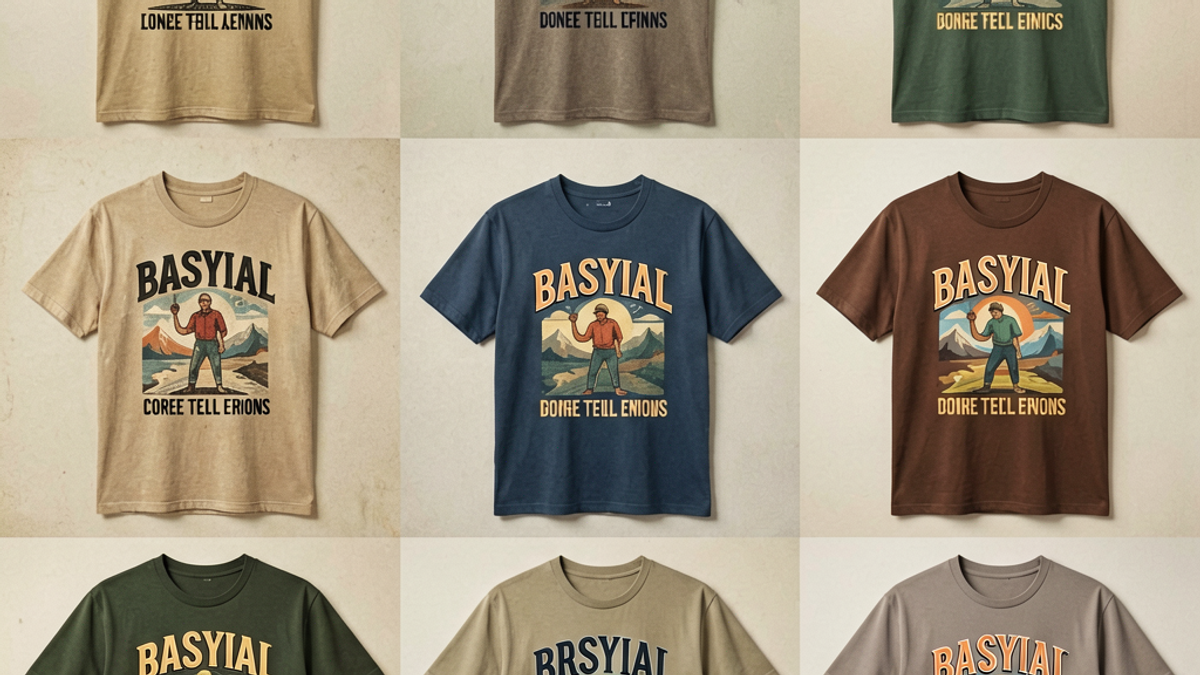
Graphic tees are still trending in 2026 because they're the cheapest canvas for self-expression with the longest shelf life in your closet. Every other garment — hoodies, denim, sneakers,...
Sylvie Vance
•
Graphic tees are still trending in 2026 because they're the cheapest canvas for self-expression with the longest shelf life in your closet. Every other garment — hoodies, denim, sneakers, outerwear — cycles through trends faster than a printed tee. A 1992 Sisters of Mercy bootleg still reads as deliberate. A 2024 Corteiz drop still reads as current. That's the whole game. The tee is the most resilient piece of personal style anyone owns, and 2026 is a year that re-proves it.
Direct answer: cheapest self-expression with the longest shelf life
The short version: graphic tees keep winning because nothing else lets you communicate this much for this little. A $35 printed tee carries a reference, a tribe, an era, and an opinion. A $35 plain tee carries a fabric. The math is obvious once you look at it through the lens of cost-per-statement.
Price floor. A graphic tee is the cheapest garment with a graphic. Hoodies, jackets, and sneakers all cost more and signal less per dollar.
Shelf life. A 1990s bootleg outlasts a 2024 hoodie in cultural currency. Prints age slowly.
Tribal reading. Graphics carry signals that fit and color can't. Anyone in the room who knows, knows.
Disposable but durable. Replaceable when the trend dies, wearable until it does.
Why trends keep cycling back to graphics
Trends don't cycle back to plain tees. They cycle back to graphics. Every 20-25 years, a generation rediscovers the printed tee as a vehicle, and every time the cycle is faster than the one before. Three reasons the loop never breaks.
Graphics are the only fashion item with a built-in expiration date that extends with age. A 2001 metallica tee was a fashion mistake in 2005 and a collectible in 2020. The same isn't true of boot-cut jeans or trucker hats. Prints gain value as they age because they accumulate reference. That's a rarity in a category built on obsolescence.
Generations need a uniform, and the printed tee is the only one that scales. Gen Z didn't invent the graphic tee — they inherited it from the punk cycle of the late 1970s, the metal cycle of the 1980s, the skate cycle of the 1990s, and the blog-era streetwear cycle of the 2000s. Every cycle picks up the same tool because nothing else does the job.
Print tech got cheap enough for anyone to start a brand. DTG printing, heat-press equipment, and on-demand fulfillment means a 22-year-old can launch a graphic tee label with $800 and a Shopify account. That wasn't true in 1996. It barely was in 2006. The result: more graphics, more variety, more reason to keep wearing them.
The 2026 forces driving the trend
Three forces made graphic tees dominant again in 2026 specifically. None of them are fads. All of them are structural.
AI art tools collapsed the design pipeline. Midjourney, Firefly, and a dozen smaller tools let a founder with no art background produce print-ready graphics in an afternoon. The volume of new graphic tees in 2024-2026 is the highest in the category's history. That volume keeps the trend visible — every feed is full of tees, every drop has a graphic, every restock is a print, not a blank.
Nostalgia cycles landed in the right window. Y2K peaked in 2022-2023. 2010s nostalgia peaked in 2024-2025. 1990s graphic tees — the bootleg metal, the vintage sportswear, the rave flyers — are now the dominant reference layer. Half the new drops on Instagram are quoting 1995 deliberately. The other half are quoting 2010 deliberately. Either way, you're wearing a graphic.
The drop economy normalized the printed tee as the unit of value. A drop is, by definition, a limited release of a printed garment. Hoodies get dropped, jackets get dropped, but the tee is what carries the drop's visual identity. Corteiz, Stüssy, Brain Dead, and the indie tier all sell drops where the tee is the hero piece and everything else is a complement. That has trained a generation of buyers to evaluate brands by their graphics first.
Generational shifts in how tees are worn
Every generation that picks up the printed tee wears it differently. The garment doesn't change much. The styling, the layering, the social rules around it all do.
The 2010s wore the graphic tee as a statement and nothing else. Tucked into raw denim, sleeves cuffed, hair styled. The graphic was the focal point. Anything that drew attention away from the print got cut from the fit.
The early 2020s layered tees under open shirts and over long sleeves. The graphic became a mid-layer — visible at the neckline and the hem, but framed by other garments. That made even a loud print feel like a detail rather than a centerpiece.
2024-2026 inverted the formula again. The graphic tee is back as a standalone piece — oversized, often boxy, often styled with a single bottom and a single shoe. The print carries the entire outfit. Layering is back, but only with neutral shells that don't compete. The message is: wear the graphic or wear a blank. Nothing in between.
Where the trend is heading next
Graphic tees aren't going anywhere in 2026-2028. But the *kind* of graphic that wins is shifting. Three directions worth tracking.
Photography-led prints are replacing illustration-led prints. The 2010s graphic was almost always vector, line-art, or hand-drawn. The 2020s graphic is increasingly a photograph — a portrait, a found image, a still from a music video. The shift started with the gallery-leaning brands and is now bleeding into the indie tier. Expect more photographic tees, fewer cartoon tees.
Text-only graphics are coming back as a counter-signal. As prints get louder and more photographic, a backlash is already forming around text-only graphics — single words, sentence fragments, no imagery. It's the same cycle that brought back the small logo after the big-logo era. If your closet is full of photo graphics, expect to want a few text tees to break them up.
Sustainability is becoming a print story, not a fabric story. A 100% organic cotton tee printed with a non-toxic water-based ink is the new floor. By 2027, brands that can't describe their print chemistry will be filtered out of the premium tier. The trend isn't the tee going away — it's the tee getting more demanding about how it's made.
Key takeaways
Graphic tees are still trending in 2026 because they remain the cheapest, longest-lived canvas for personal style.
Trends cycle back to graphics, not to plain tees — every 20-25 years a new generation rediscovers the printed garment as a vehicle.
Three structural forces are driving 2026's trend: AI art tools collapsing the design pipeline, the 1990s nostalgia cycle landing on schedule, and the drop economy making the tee the unit of value.
How tees are worn keeps shifting: the 2024-2026 formula is the graphic as a standalone piece, oversized, minimally layered, with the print carrying the entire outfit.
What's next: photography-led prints replacing illustration, text-only graphics coming back as a counter-signal, and sustainability shifting from a fabric story to a print chemistry story.
The bottom line
Graphic tees will outlast every other category of streetwear trend in 2026. They're the cheapest canvas with the longest shelf life, and 2026 is the year that thesis gets tested and confirmed again. The brands that win are the ones designing the graphic first and the garment second — and the customers who win are the ones who buy the print, not the hype. Start with the references you actually carry, build from a heavy blank and a real print method, and let the Stryxen Studio collection be the next tee you actually wear for the next five years. The trend isn't the tee. The trend is the *kind* of tee you choose. Choose well.
Frequently Asked Questions
Why are graphic tees still so popular in 2026?
Because no other garment communicates as much per dollar. A $35 graphic tee carries a reference, a tribe, an era, and an opinion; a $35 plain tee carries fabric. The printed tee is also the only fashion item that gains cultural value as it ages, which is rare in a category built on obsolescence. Add in the 2026 forces — AI art tools, the 1990s nostalgia cycle, and the drop economy — and the category is more dominant than it was five years ago, not less.
Are graphic tees actually trending again or is that just marketing?
It's real. The volume of new graphic tee labels launched in 2024-2026 is the highest in the category's history, driven by cheap print tech and AI design tools. Resale markets for cult graphic tees are also at record levels. The 1990s nostalgia cycle landing on schedule is a separate force that's pulling vintage graphic tees back into rotation. None of this is manufactured — it's structural.
What kind of graphic tees are trending in 2026?
Photography-led graphics are replacing illustration-led graphics as the dominant style. The 2010s graphic was almost always vector or hand-drawn; the 2026 graphic is often a photograph, a found image, or a still. Loud, oversized, boxy silhouettes are also winning over slim fits. A counter-trend of text-only graphics — single words, no imagery — is forming as a backlash to the louder prints.
Will graphic tees go out of style?
Eventually, but not in this decade. The graphic tee is the only fashion item with a built-in expiration date that extends with age, which is why trends keep cycling back to it instead of past it. Plain tees come and go. Drop silhouettes come and go. The printed tee is the constant. Expect the *kind* of graphic to keep shifting — photography, text, collage, AI prints — but the printed garment itself is durable through at least 2028.
Free Shipping on All OrdersFree ReturnsNo Hidden Fees
 Sylvie Vance