What kind of tricks or maneuvers are expected from top competitors in women's snowboarding halfpipe?
Elite women's snowboarding halfpipe requires massive amplitude and complex aerials like 1080s and 1260s to compete for the podium.
 Sylvie Vance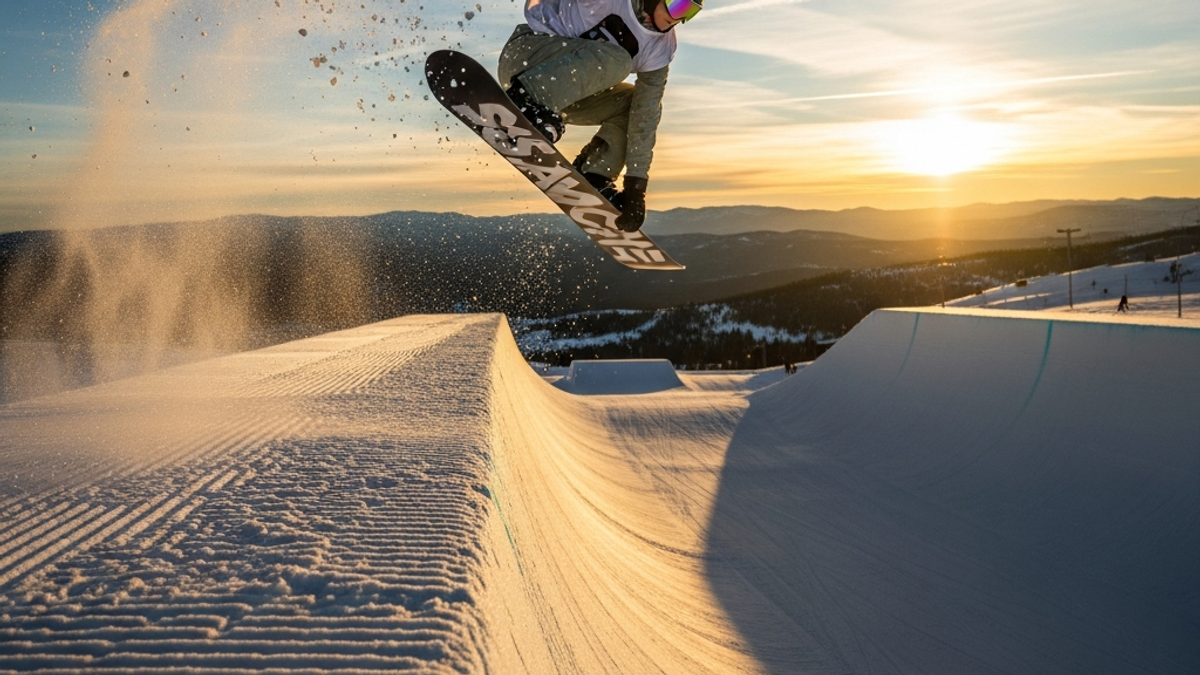
Top competitors in the Women's Snowboarding Halfpipe are expected to showcase highly technical, progressive maneuvers, including multiple rotations such as **1080s** and **1260s**, often combined with complex grabs and exceptional amplitude, as seen in the runs of champions like Chloe Kim, who has demonstrated 1080s and massive air over the lip of the pipe (https://www.nbclosangeles.com/olympics/2026-milan-cortina/snowboarding-chloe-kim-maddie-mastro-halfpipe-final/3845359/). As the 2026 Winter Olympics approach, the pursuit of higher rotational difficulty and amplitude continues to define the elite standard in this discipline.
### What are the defining technical elements of a winning women's halfpipe run?
A winning run in elite women's snowboarding halfpipe is defined by a combination of **Amplitude**, **Variety**, **Execution**, and **Degree of Difficulty (DOD)**. Amplitude, or how high a rider launches above the coping (the edge of the pipe), is critical, as greater height allows for more time to complete complex rotations. The key maneuvers defining the current top tier include multiple variations of **1080-degree spins** (three full rotations) and, increasingly, **1260-degree spins** (three and a half rotations) (https://www.nbclosangeles.com/olympics/2026-milan-cortina/snowboarding-chloe-kim-maddie-mastro-halfpipe-final/3845359/). Furthermore, execution must be flawless, meaning every spin must be accompanied by a clean grab—such as a Mute, Indy, or Melon—and the transitions between tricks must be seamless, leading into the next wall with speed and control.
### How has the required difficulty evolved leading into the 2026 Winter Games?
The evolution in the women's halfpipe is characterized by a consistent push toward higher rotational complexity, largely driven by athletes like Chloe Kim. In past competitions, a clean 900 (two-and-a-half rotations) was often sufficient for medal contention, but the standard has clearly shifted (https://www.youtube.com/watch?v=qsG0IQ_vaMo). To remain competitive for the Milano Cortina 2026 podium, athletes are now required to land multiple 1080 variations consistently within a single run (https://www.nbclosangeles.com/olympics/2026-milan-cortina/snowboarding-chloe-kim-maddie-mastro-halfpipe-final/3845359/). This escalation in DOD forces competitors to push their physical and mental limits, as under-rotation or a fall on a high-difficulty trick results in significant point deductions.
### Beyond the Halfpipe: How does Ice Dancing contrast with Snowboarding Halfpipe in terms of required technical skill?
While both disciplines demand peak athleticism, the required technical skills for Ice Dancing and Women's Snowboarding Halfpipe are fundamentally different due to the medium. Ice Dancing (part of Figure Skating) prioritizes intricate **edge work, precise synchronization, deep edges**, and **complex rotational lifts** executed on a flat surface, where the scoring heavily weights the interpretation of music and pattern execution (https://www.olympics.com/en/milano-cortina-2026/results/sbd/w/hp----------------/race-sports-event-ranking). In contrast, Snowboarding Halfpipe relies on **aerial maneuvers, vertical height (amplitude)**, and **rotational complexity** within a curved, vertical structure (https://www.youtube.com/watch?v=qsG0IQ_vaMo). Where ice dancers achieve height via centrifugal force and leverage on the ice, snowboarders use momentum generated by the transition walls of the halfpipe.
### What role does 'Amplitude' play in judging the performance metrics?
Amplitude is arguably the most visually impressive and numerically significant component of a halfpipe score, often directly influencing the overall "wow factor" needed to impress judges. In the context of elite judging, greater amplitude provides the necessary "hang time" to complete difficult tricks cleanly; for instance, a rider launching significantly above the coping is frequently highlighted as a marker of superior performance (https://www.nbclosangeles.com/olympics/2026-milan-cortina/snowboarding-chloe-kim-maddie-mastro-halfpipe-final/3845359/). High amplitude translates directly into higher base scores, as it demonstrates the rider's mastery over the speed and trajectory required to conquer the massive 22-foot walls of an Olympic-standard halfpipe.
### Key Takeaways: Preparing for Olympic-Level Snowboarding Halfpipe
Understanding the demands of the Women's Snowboarding Halfpipe competition reveals a sport defined by relentless progression and technical execution.
* **Rotational Benchmark:** The **1080** remains the required cornerstone maneuver, with successful **1260s** providing a significant scoring advantage.
* **Amplitude is Non-Negotiable:** High air time above the coping is necessary to maximize the time available for completing high-scoring, complex maneuvers.
* **Execution Trumps Quantity:** Flawless landings and clean execution of difficult grabs elevate a good run to a winning run, even if the sheer number of tricks is slightly lower than a competitor.
* **Divergence from Ice Sports:** Unlike the precision and interpretation central to Ice Dancing, Halfpipe success hinges on mastering vertical space and aerial rotations.
The future trajectory points toward the introduction of even more aggressive rotational inversions, potentially pushing the boundaries beyond the 1260, contingent upon athlete safety and the physical limits of the current halfpipe infrastructure.
The journey to the 2026 podium in Women's Snowboarding Halfpipe will be marked by athletes who not only possess raw athletic talent but also the strategic courage to push the established rotational limits, landing maneuvers once thought impossible. As these incredible athletes prepare for Milano Cortina, spectators can anticipate a display of air, grace, and technical difficulty that will redefine the peak of the sport.