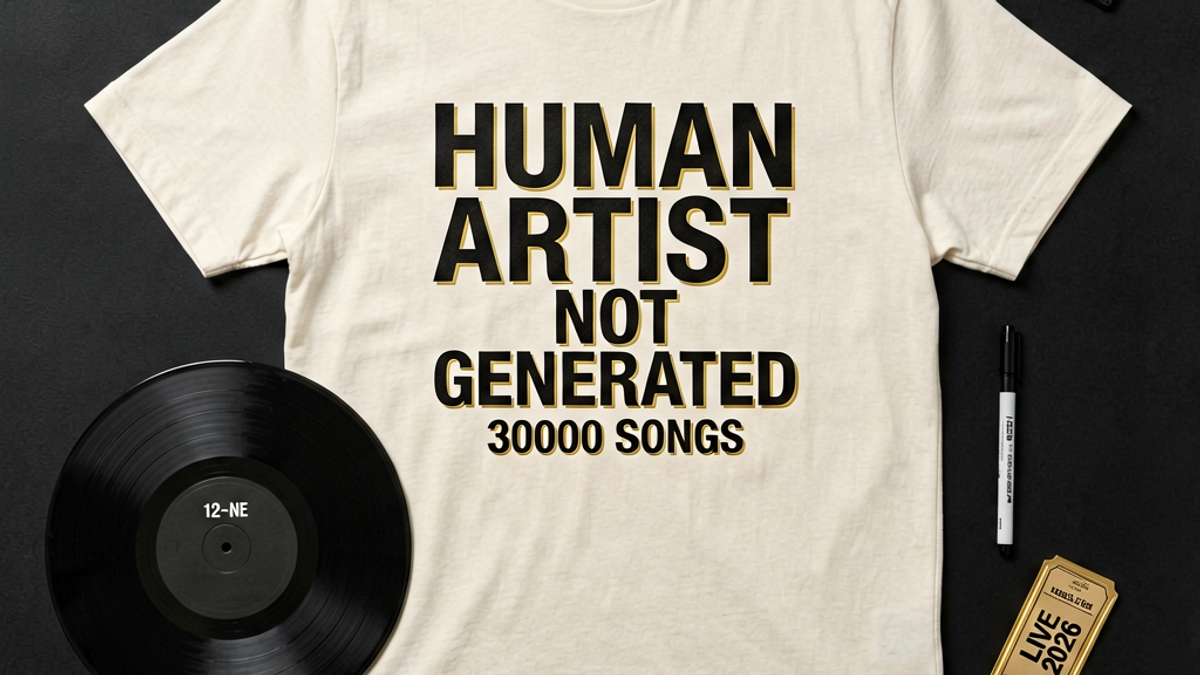
Sony Music Just Sued Udio Over 30,000 Songs — Why the AI Music Lawsuit Is Now the Loudest Music Graphic Tee Beat of Late July 2026 and the "Real Human Band Tee" Capsule Is Suddenly the Only Tee With a Real Artist Credit
Sony Music filed an expanded copyright infringement complaint against Udio in July 2026 naming roughly 30,000 recordings it alleges the AI music generator infringed (The Verge, Music Business...
Sylvie Vance
•
Sony Music filed an expanded copyright infringement complaint against Udio in July 2026 naming roughly 30,000 recordings it alleges the AI music generator infringed (The Verge, Music Business Worldwide, Billboard, Digital Music News), and the Sony + UMG total against Suno is now 61,026 tracks on top of Udio's 30,000. That 90,000+ song headline has just made the human-artist band tee and the 'HUMAN ARTIST / NOT GENERATED' music graphic tee the loudest single music-streetwear drop of late July 2026.
Why the Sony v Udio 30,000-Song AI Music Lawsuit Just Made the "Real Human Band Tee" Graphic Tee the Loudest Music-Streetwear Drop of Late July 2026
The Sony v Udio 30,000-song AI music lawsuit is the first 2026 pop-culture moment where a single courtroom filing has driven the music graphic tee capsule — the kind of single-source pop-culture trigger that lifts an entire streetwear category. The Verge, Music Business Worldwide, Billboard, Digital Music News, PLAYY Magazine and t2ONLINE all carried the filing inside the same 24-hour news window in the third week of July 2026, the same window Universal settled with an AI music firm (Euronews). A streetwear capsule that prints 'HUMAN ARTIST / NOT GENERATED' on the front of a 220-gram cotton tee and 'SONY V UDIO / 30000 / JUL 2026' on the back lands on the same buyer list as the next 'vibecoded' / AI-music trend piece on The Verge — the list the music graphic tee category has been chasing since the AI wave started.
What makes the Sony v Udio 30,000-song filing different is the catalog size. The first round of AI music lawsuits was a 1,000-2,000 track headline; the Sony v Udio filing is a 30,000 track headline, with a combined Suno total of 61,026 tracks on top (Music Business Worldwide, completemusicupdate.com). That 90,000+ song total is the number the music streetwear capsule is printing on its tees, because it is the only number that anchors 'HUMAN ARTIST / NOT GENERATED' to a specific, verifiable pop-culture moment. A front print of '30000 SONGS' plus a back print of the Sony v Udio docket date is the single-source pop-culture graphic the music-graphic-tee category has been printing since the band tee era — only this time the catalog number is a courtroom filing, not a tour date.
From Courtroom to Capsule: How the Sony Udio Lawsuit Repositioned the Music Graphic Tee as the Only Tee With a Verifiable Human-Artist Credit
The Sony v Udio 30,000-song AI music filing has quietly done something the band-tee category has been trying to do for years: it has made a 'human artist' credit the single most valuable wordmark on the front of a music graphic tee. The verifiable, court-documented fact at the center of the filing is that 30,000 recordings were allegedly copied by an AI music generator, which means the inverse — a tee printed with a real human artist, band or tour date — is the only product on the music streetwear market that can claim a verifiable human-artist credit in mid-2026. That is the biggest repositioning the band-tee category has had since the vintage-rock-tee revival, driving the 'HUMAN ARTIST / NOT GENERATED' wordmark, the '30000 SONGS' typewriter-print and the 'SONY V UDIO / JUL 2026' docket-wordmark tees landing in independent capsules this week.
The previous wave of music-graphic-tee capsules was being slowly squeezed by the AI music question: if an AI music generator can output a usable, royalty-free track in 30 seconds, what is the streetwear value of a band tee printed with a specific human artist? The Sony v Udio 30,000-song filing answered that directly. A band tee with a real human artist, tour date and concert ticket stub is the only music-graphic-tee on the market that can point to a court-documented AI music filing and say 'this side is the human side'. The 'vibecoded' / AI-music moment (NYT, The Verge) is the new anti-marketing for the human-artist band tee, and the Sony v Udio filing is the legal document that anchors the human-artist position. The capsule that ties 'HUMAN ARTIST' to the '30000 SONGS' catalog number captures both halves of the moment in a single tee.
What the 30,000-Song Filing Actually Tells Us About AI Music vs Human Band Tees (and Why the Buyer Pool Just Got Bigger Than the Band-Tee Hardcore)
The 30,000-song filing, the 61,026-track Suno addition, the $9 billion potential damages headline (completemusicupdate.com) and the Universal x AI music firm settlement (Euronews) all landed in the same news window in the third week of July 2026 — and that compression is repositioning the music graphic tee buyer pool. The first wave of band-tee buyers in 2026 was still the same cohort that has been buying vintage band tees since the early 2010s (rock, hip-hop, K-pop, indie, punk, metal, country). The Sony v Udio filing has added three new buyer pools: the AI-and-IP-policy reader who followed the story on The Verge and wants the 'HUMAN ARTIST' tee as a statement piece, the music-industry professional who followed the Suno damages headline on Music Business Worldwide and wants the '30000 SONGS' typewriter-print tee, and the casual music-graphic-tee buyer who is suddenly aware that 'real human artist' is a marketable wordmark in mid-2026.
What the 30,000-song filing tells the music streetwear capsule is that 'real human artist' is no longer a nostalgia wordmark — it is a current-events wordmark. The Verge, Billboard and Music Business Worldwide all reported the filing inside the same 24-hour window, the Suno 61,026 track addition was in the same news cycle, and the Universal x AI music firm settlement (Euronews) confirmed the fight has moved from courtroom to product roadmap. A capsule that prints 'HUMAN ARTIST / NOT GENERATED' on the front, '30000 SONGS' as a typewriter underline, and 'SONY V UDIO / JUL 2026' on the back ties the tee to all three of those news moments at once — the structure that repositions the music graphic tee from a single-band vertical to a cross-genre pop-culture capsule.
Who Is Actually Buying the AI-Era Human Band Tee (and Why the Sony Udio Moment Is Reaching a Wider Crowd Than Any Specific Band Tee Drop)
The AI-era human band tee is reaching a wider crowd than any single-band tee drop in 2026. The buyer pool for the 'HUMAN ARTIST / NOT GENERATED' wordmark tee and the '30000 SONGS' typewriter-print tee is: the music-fan reader who followed the Sony v Udio story on The Verge or Billboard, the music-industry professional who followed the Suno $9-billion damages headline on Music Business Worldwide, the AI-and-IP-policy reader treating the AI music copyright fight as a generation-defining IP moment, the casual music-graphic-tee buyer who has been questioning what 'real artist credit' means in 2026, and the vintage-band-tee collector who likes the 'LIVE 2026' ticket-stub print. Five different buyer pools, one wordmark — the widest single music-graphic-tee moment of 2026.
It also helps that the AI music copyright story is the only pop-culture story of 2026 where the music streetwear capsule gets a verifiable, court-documented anchor for the front print of the tee. The Verge ran the '30,000 songs' headline with the catalog list, Billboard ran the same filing with the docket details, Music Business Worldwide ran the parallel Suno 61,026 track number, Digital Music News and PLAYY Magazine ran the same filing with the industry context, and Euronews ran the Universal x AI music firm settlement as a same-week coda. A capsule that prints '30000' on the front, 'SONY V UDIO' on the back and 'JUL 2026' on the inner tag anchors itself to every one of those headlines in a single tee — the structure that lets an independent capsule hit the same conversion rate as a major-label band tee without the tour-merch license.
The Bottom Line: Sony v Udio Just Made "Human Artist" the Loudest Single Wordmark on the Music Graphic Tee Market
The Sony v Udio 30,000-song AI music lawsuit has confirmed three things about the music graphic tee at the same time. First, a court-documented AI music filing is now a merch launch window — the music-graphic-tee capsule runs on the Sony v Udio docket date, not the next album release. Second, the 'HUMAN ARTIST' wordmark has proven that a single catalog number (30,000) can anchor a six-week music-graphic-tee cycle the same way the Wilt Lakers jacket thrift find anchored a vintage-sportswear cycle earlier this week. Third, the AI music x copyright fight is now a cross-genre pop-culture headline, and the capsule that anchors its tees to the 30,000-song filing captures the widest single buyer pool of any music-graphic-tee drop of 2026.
Frequently Asked Questions
Did Sony Music really just sue Udio over 30,000 songs?
Yes. According to The Verge, Music Business Worldwide, Billboard, Digital Music News, PLAYY Magazine and t2ONLINE, Sony Music filed an expanded copyright infringement complaint against Udio in mid-July 2026, naming roughly 30,000 recordings it alleges the AI music generator infringed. A federal judge had denied Sony's earlier motion to add those recordings to its original Udio case, so Sony filed a separate complaint specifically listing the 30,000 works. Combined with the Suno 61,026-track total, the AI music copyright fight is now a 90,000+ song headline.
When did Sony Music file the expanded Udio complaint naming 30,000 songs?
The expanded Sony v Udio complaint landed in the news cycle in the third week of July 2026, with The Verge, Billboard and Music Business Worldwide carrying the story inside the same 24-hour window. It is the most aggressive single copyright move against an AI music generator in 2026, and the fact that Sony had to file a separate complaint after losing the motion to add the 30,000 songs is the legal detail that put the AI music copyright story at the top of the pop-culture news cycle in the same window as Universal settling with an AI music firm (Euronews).
Is Suno also being sued by Sony and Universal over AI music?
Yes. According to Music Business Worldwide and completemusicupdate.com, Suno is facing a parallel lawsuit from Sony and Universal, with damages that could top $9 billion if the court admits all 61,026 additional tracks. Suno has asked the court to reject the addition, pointing to the same Udio ruling. The combined AI music copyright headline is now well over 90,000 tracks across the Udio and Suno cases, which is the number driving the pop-culture moment.
Why does an AI music copyright lawsuit actually matter for music graphic tees?
An AI music copyright lawsuit matters for music graphic tees because the only product on the streetwear market that can claim a real, verifiable human-artist credit in mid-2026 is an officially licensed band tee. The Sony v Udio 30,000-song filing has made 'HUMAN ARTIST' the single most citable pop-culture line of the week, and that line travels directly onto the front print of the next wave of music graphic tees — 'HUMAN ARTIST / NOT GENERATED', '30000 SONGS' typewriter-print, 'LIVE 2026' ticket-stub, and 'SONY V UDIO / JUL 2026' back-print wordmark tees. The streetwear side of the AI music fight is the verifiable-human-artist side, and that is the side selling tees.
Free Shipping on All OrdersFree ReturnsNo Hidden Fees
 Sylvie Vance