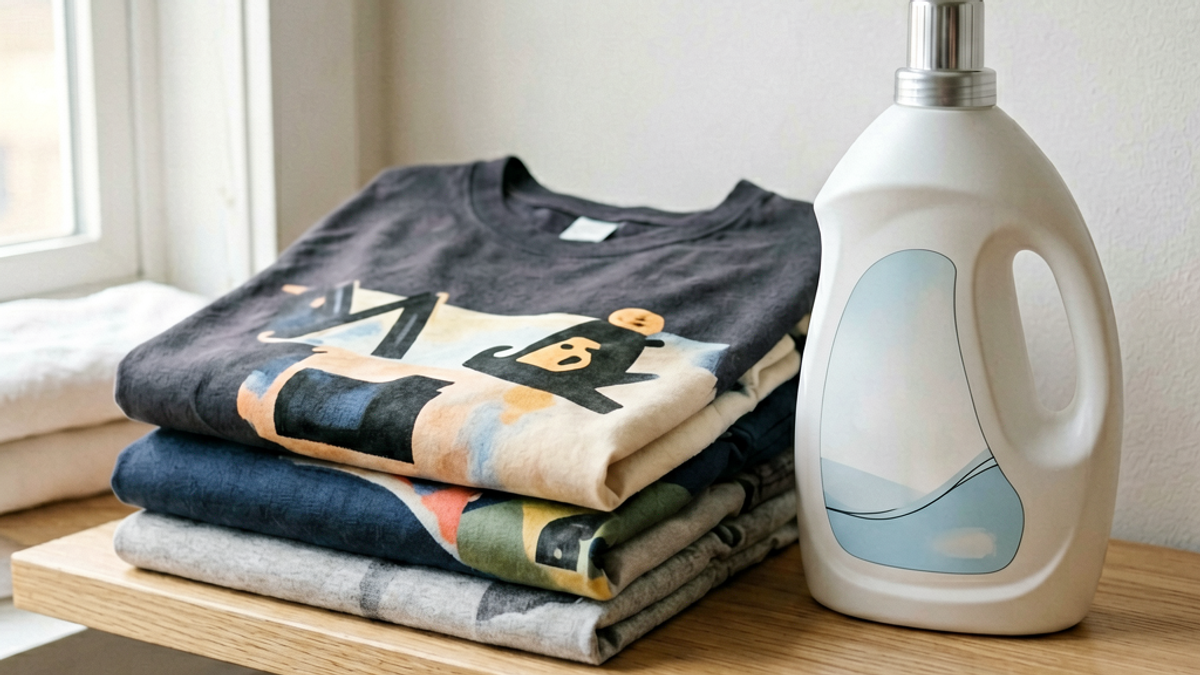
How Do You Wash and Care for Graphic Tees So Prints Don't Crack or Fade?
Wash graphic tees inside out in cold water — 30°C / 86°F or lower — with a mild liquid detergent, then hang or lay flat to dry. Skip the tumble dryer, skip the iron on the print, and skip fabric...
Sylvie Vance
•
Wash graphic tees inside out in cold water — 30°C / 86°F or lower — with a mild liquid detergent, then hang or lay flat to dry. Skip the tumble dryer, skip the iron on the print, and skip fabric softener. Those four moves are what separate a tee whose print lasts four years from one whose graphic is peeling off the chest by month eight. Everything else in this guide is the reason those four moves work, plus the smaller mistakes that quietly destroy prints even when the laundry basics look right.
How to Wash Graphic Tees: The Four-Move Rule That Saves the Print
Before any routine, four rules carry roughly 90% of the lifespan of a printed tee. Internalize these and the rest of this article is just supporting detail.
Cold water only. Heat is the print's enemy. 30°C is the safe ceiling; anything above 40°C starts softening plastisol ink and breaking down the cotton fibers that anchor it.
Inside out, every time. Flipping the tee protects the print from agitation against the drum, zippers in the same load, and direct UV if you end up line-drying in the sun.
Skip the tumble dryer. Radiant heat from a dryer cycles the print between hot and cool, and the cracking that produces is irreversible. Air-dry flat or on a hanger.
No iron, no softener on the print. If you must press a wrinkle, iron the back side with a cloth barrier, low heat, no steam.
The 6-Step Wash Routine, in Order
A repeatable routine beats winging it every Sunday. The order matters — pre-treat before the wash, don't wring before the dry, and never store a damp tee. Here is the sequence we recommend and the reasoning behind each step.
Step 1 — Pre-treat stains before the wash
Hit underarm sweat, collar rings, or any food spot with a pea-sized drop of the same mild detergent you'll use in the wash. Work it in gently with your finger, wait five minutes, then move to step 2. Pre-treating means the main wash cycle can stay short and cold — both good for the print. Skip bleach, skip oxy-clean boosters that contain sodium percarbonate on dark prints; they lift the base color faster than they lift the stain.
Step 2 — Sort by color and weight, not by fabric type
Don't wash a heavyweight graphic hoodie with a lightweight pocket tee — the agitation needed to clean the heavier piece shreds the lighter one. Group by color (darks, lights, brights) and by weight. Keep printed tees away from anything with Velcro, exposed zippers, or hooks. A single hook snag can lift a corner of a screen print permanently.
Step 3 — Cold cycle, inside out, gentle detergent
Set the machine to cold or 30°C, gentle or delicate cycle, and a low spin speed (600–800 rpm). Flip each tee inside out before it goes in. Use about half the detergent dose you'd use for a regular load — modern HE machines need far less soap than the cap suggests, and excess detergent is what leaves the stiff residue that makes prints feel crusty after a few washes.
Step 4 — Remove promptly when the cycle ends
Tees left in a wet drum for hours develop mildew smell, set-in wrinkles, and — the part people miss — the print stays saturated against the metal or another garment. Hang or lay flat within ten minutes of the cycle finishing. Don't wring; pressing water out twists the fibers under the print and can cause micro-cracks along the edges of the graphic.
Step 5 — Air dry flat or on a wide hanger
Lay flat on a clean towel for the best result on heavyweight prints. If you hang, use a wide wooden or padded hanger — wire hangers leave shoulder dents and put stress on the neck binding. Direct sun is fine for short periods (under an hour) but prolonged UV will bleach the base fabric and yellow white prints. Indoor drying on a rack takes 6–12 hours depending on humidity.
Step 6 — Store folded, not crammed on a hanger
Long-term hanging stretches the neck and shoulders of a printed tee, and the print bears most of that tension — especially across the chest. Fold and stack in a drawer or on a shelf. If you must hang for a photo or to display, use a wide hanger and don't leave it for more than a few days.
Detergent and Water Temperature: What to Use and What to Skip
The wrong detergent will age a print faster than almost any other variable. Here is the shortlist of what works, what to avoid, and why temperature is non-negotiable.
Mild liquid detergent, fragrance-free if possible. Liquids dissolve fully in cold water; powders can leave undissolved grains that grind against the print surface.
Skip bleach and chlorine-based whiteners. They oxidize the pigments in both the print and the base fabric. Whites go grey, blacks go rust.
Skip fabric softener on the printed side. Softener coats the print to soften the fabric — exactly the wrong direction. It also reduces the ink's grip on the cotton fibers.
30°C / 86°F is the safe ceiling. 40°C is the threshold where plastisol begins to soften on repeated cycles. Below 30°C you'll get the clean you need if you pre-treated stains; cold is fine for routine wears.
Hard water? Add a water-softening agent. Mineral-heavy water leaves deposits inside the print that dull the colors over time. A cheap softening cartridge on the inlet hose solves it without changing detergent.
Drying Mistakes That Destroy Prints (Even When the Wash Was Perfect)
Most ruined graphics were washed correctly and then thrown in the dryer "just for ten minutes." Those ten minutes are where the print dies. Heat and mechanical tumble are the two forces that crack cured ink, and a dryer hits the print with both at once.
The pattern of cracking from dryer damage is recognizable: hairline fractures that follow the print outline, peeling at the edges first, and the print feels slightly tacky or soft compared to a properly air-dried tee. Once you see it, you can't unsee it. The fix is to commit to air drying — or, if you absolutely must use a dryer, run it on no-heat / air-fluff for under five minutes to knock out wrinkles, then hang to finish.
Wringing is the other silent killer. Twisting the wet tee to squeeze out water puts shear stress on the bond between ink and cotton. The print survives one or two wrings; over fifty washes of wringing, edges lift and micro-cracks appear across the graphic. Press the water out with a towel instead — roll the tee in a dry towel, press, unroll, hang.
Ironing and Steaming Without Melting the Print
Most graphic tees don't need ironing. The cotton relaxes on your body after ten minutes of wear, and a flat dry rarely leaves deep wrinkles. But when you do need to press one — for a photo, an event, or a stubborn fold line — the technique matters.
Iron the back side, never the print. Set the iron to low or cotton-low and run it across the inside of the tee. The heat reaches the print indirectly and at lower intensity.
Use a press cloth. A plain cotton handkerchief or pillowcase between iron and fabric adds a buffer. Without it, even low heat can scorch the print's surface and leave a shiny patch.
No steam directly on the print. Steam dissolves plastisol slowly; the print looks fine after one pass and dull after five. If you steam, keep the nozzle 20+ cm away and move constantly.
DTG and water-based prints are more fragile than plastisol. Direct-to-garment prints soak the ink into the cotton rather than sitting on top of it, which means heat reactivates the dye and can ghost a previous crease permanently into the print. Treat them like a delicate cotton shirt, not a work tee.
How Long a Well-Cared Graphic Tee Should Actually Last
A printed tee that's washed correctly should look sharp for 3–5 years of regular rotation — call it 80–120 wears. The print won't be as crisp as day one; that's the cotton relaxing, not the print failing. The signs of a print that aged well versus one that failed are easy to distinguish.
Aged well: print edges are slightly softer, colors have mellowed one shade, fabric has a softer hand-feel. The graphic is fully intact.
Aging badly: hairline cracks across the print, edges lifting, fabric feeling stiff or sticky where the graphic is. These are heat, softener, or dryer damage — all preventable.
Rotation matters. A tee worn once a week and washed each time lasts two years. A tee worn once a week and washed every third wear lasts four-plus. The less often the print goes through a wash cycle, the longer it lives.
Storage in sunlight kills prints faster than washing. A tee displayed in a sunlit window fades in months; the same tee in a drawer keeps its color for years. UV is the slow poison of pigment.
Key Takeaways
Cold wash, inside out, mild liquid detergent, hang dry. Four moves cover most of the lifespan gain.
The dryer is the print's biggest enemy — more damaging than hot water, more damaging than detergent choice.
Skip fabric softener and bleach. Both chemically attack the print bond and the base pigment.
Iron from the inside, with a cloth barrier, low heat, no steam — or skip the iron entirely.
A cared-for graphic tee lasts 3–5 years of regular rotation. A neglected one starts cracking by month eight.
Treat the graphic tee like the printed piece it is, not like a basic undershirt. Cold water, inside out, hang dry, no softener — the routine takes an extra thirty seconds per load and adds years to the print. The Stryxen Studio collection is built to be worn, washed, and worn again; follow the steps above and the graphic stays as sharp as the day it shipped.
Frequently Asked Questions
How often should I actually wash a graphic tee?
Every 2–3 wears is the realistic sweet spot for most cotton graphic tees. Single-wear washing is overkill unless the tee is visibly soiled or sweat-soaked. Each wash cycle — no matter how gentle — stresses the print bond and the cotton fibers, so fewer cycles means longer print life. Hang to air out between wears to reduce odor without a wash.
Can I put graphic tees in the dryer on low heat?
Low heat is better than high heat, but it's still heat, and any tumble action adds mechanical stress. If you must use a dryer, run no-heat / air-fluff for under five minutes to knock out wrinkles, then finish on a hanger. The honest answer is: skip the dryer entirely if you want the print to last past two years.
What detergent is best for graphic tees?
A mild, fragrance-free liquid detergent is the safe default. Liquids dissolve fully in cold water; powders can leave undissolved grains that grind against the print surface. Skip bleach, skip chlorine whiteners, and skip fabric softener on the printed side. Most mainstream "gentle" or "delicate" formulas work — you don't need a specialty garment wash.
How do I get wrinkles out of a graphic tee without ruining the print?
The simplest answer: don't iron the printed side. Flip the tee inside out, set the iron to low heat, and press the back of the graphic with a thin cotton cloth (a handkerchief works) between iron and fabric. Skip steam on the print. If you have a steamer, hold it 20+ cm away from the graphic. For most wrinkles, hanging the tee in a steamy bathroom for ten minutes does the job without any direct heat on the print.
Free Shipping on All OrdersFree ReturnsNo Hidden Fees
 Sylvie Vance